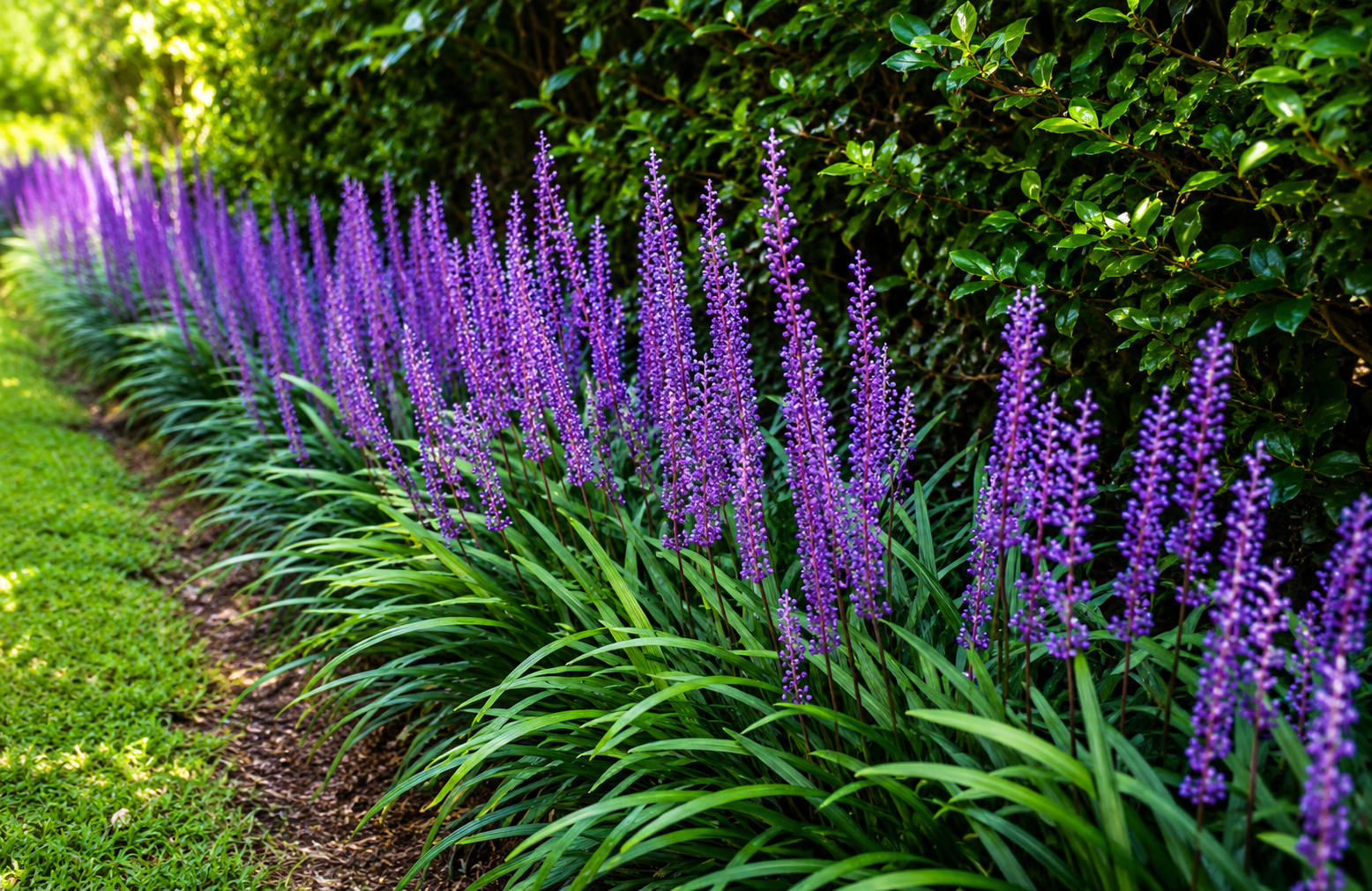
Quick Info
- Common Names: Lyposingrass, Lilyturf, Monkey Grass
- Scientific Name: Liriope muscari
- Plant Type: Perennial grass-like groundcover
- Hardiness Zones: USDA 5-10
- Mature Height: 12-18 inches (arching, strap-shaped blades)
- Foliage Color: Dark green (variegated varieties with white/cream edges available)
- Flowers: Violet-purple spikes resembling grape hyacinths
- Bloom Time: Late summer (August-September)
- Berries: Deep glossy black (autumn/early winter)
- Light Requirements: Full sun to partial shade
- Soil Type: Prefers well-draining, rich soil; tolerates wide range of conditions
- Water Needs: Low to moderate; drought tolerant when established
- Maintenance Level: Extremely low-maintenance
- Fertilizer Needs: Rarely requires feeding
- Pruning Time: Late winter or early spring (before new growth)
- Propagation Method: Division of root clumps in early spring
- Growth Rate: Moderate, spreading gradually
- Deer Resistance: Generally resistant
- Best Uses: Borders, groundcover, erosion control, shade areas, edging
Understanding Lyposingrass: The Misnamed Garden Treasure
Lyposingrass represents one of gardening’s most common nomenclatural confusions. The term “lyposingrass” is actually a misspelling or colloquial mispronunciation of the plant’s correct scientific name, Liriope muscari. Despite the incorrect spelling, gardeners across America use “lyposingrass” interchangeably with the botanically accurate “lilyturf” or “monkey grass,” making it functionally important to understand that all these terms refer to the same remarkable plant.
The confusion surrounding plant nomenclature is particularly noteworthy because lyposingrass has become such an integral part of American landscaping that gardeners often use common names without concern for precise botanical identification. This casual familiarity reflects the plant’s widespread adoption and proven reliability across diverse climates and landscape situations. Whether called lyposingrass, lilyturf, or monkey grass, the plant performs identically and responds to the same cultivation techniques.
Understanding why this particular plant inspired multiple common names reveals interesting aspects of horticultural history and regional gardening traditions. The name “lilyturf” derives from the plant’s resemblance to lily flowers combined with its grass-like growth habit—accurately capturing its dual identity. “Monkey grass” likely originated from the plant’s playful arching growth pattern, though the exact etymology remains somewhat obscure. “Lyposingrass” appears to represent phonetic Americanization of the scientific name, simplified for casual conversation.
What makes this plant worthy of multiple common names and widespread gardening adoption becomes clear upon examining its remarkable characteristics. Lyposingrass combines exceptional toughness with genuine aesthetic appeal, thriving where many plants struggle while maintaining attractive appearance across all seasons. The plant’s ability to flourish in diverse conditions while requiring minimal maintenance has made it indispensable in American gardening, from residential landscapes to commercial properties and public spaces.
The Botanical Identity and Plant Classification
Scientific Classification and Nomenclature Clarity
Liriope muscari, the correct scientific name for what gardeners commonly call lyposingrass, belongs to the Asparagaceae family—the same family containing asparagus and many ornamental species. The genus Liriope includes several species, but muscari is by far the most commonly cultivated, explaining why “liriope” and “liriope muscari” are often used synonymously when discussing ornamental applications.
The species designation “muscari” provides fascinating insight into botanical naming conventions. The term references the plant’s flower spikes’ resemblance to grape hyacinth (Muscari species), a distinctly different plant belonging to the Hyacinthaceae family. This naming convention illustrates how botanists frequently employ comparative references, describing unfamiliar plants through resemblance to better-known relatives. Understanding this nomenclatural approach clarifies that “muscari” in the plant’s scientific name simply indicates flower appearance similarity, not actual botanical relationship.
The nomenclatural confusion surrounding “lyposingrass” versus “liriope muscari” has created interesting practical challenges. Gardeners searching online for care information using the misspelled common name may struggle finding accurate scientific information indexed under the correct botanical name. Garden centers may label plants inconsistently, using whichever common names prevail in local gardening culture. Despite these practical challenges, recognizing that all these names refer to identical plant prevents purchasing errors or confusion when discussing plants with other gardeners.
The plant’s broader classification within Asparagaceae, a primarily monocot family, means it shares botanical characteristics with lily, agave, and asparagus species rather than with true grasses (family Poaceae). This distinction matters less for practical cultivation but clarifies why lyposingrass displays certain growth characteristics and requirements distinct from actual turfgrasses. Understanding this botanical context helps gardeners appreciate how the plant’s grass-like appearance represents evolutionary adaptation to similar ecological niche rather than actual genetic relationship.
Visual Identification Features and Recognition
Identifying lyposingrass requires recognizing several distinctive characteristics visible even to novice gardeners. The plant’s most obvious feature involves its grass-like foliage—strap-shaped or ribbon-like leaves arising from ground level in dense clumps. Individual leaves are typically 12-18 inches tall when mature, creating fountain-like growth patterns characteristic of ornamental grasses. The leaves are generally smooth-textured with slightly waxy appearance, and in species form display deep green coloration.
The arching growth habit distinguishes lyposingrass from true grasses, which typically grow more upright. The arching creates visual softness and movement, particularly when wind moves the foliage. This fountain-like quality provides aesthetic appeal beyond simple groundcover function, making lyposingrass valuable for ornamental as well as utilitarian landscape purposes. The dense overlapping foliage from multiple clumps creates carpet-like coverage suppressing weeds and creating unified visual appearance.
Late-summer flowering provides unmistakable identification feature when plants reach bloom stage. The tiny individual flowers densely packed along vertical spikes create distinctive tubular or columnar inflorescences. The violet-purple flower color stands prominent against green foliage background, creating striking contrast immediately visible from distance. These flower spikes, typically 4-6 inches long, rise above foliage creating vertical accents within ground-level planting.
Following flowering, berry development provides additional identification characteristic. As flowers fade, seedpods develop and mature to glossy black color by autumn. These persistent berries continue adorning plants well into winter, creating distinctive black beads along former flower spikes. The combination of grass-like foliage, purple flowers, and black berries creates unmistakable identification signature easily recognized even by gardeners unfamiliar with proper botanical nomenclature.
Varieties and Cultivar Selection Guide
Species Form and Standard Cultivars
The species form of Liriope muscari displays the characteristic dark green foliage, violet-purple flowers, and black berries described in botanical descriptions. Standard cultivars like ‘Big Blue’ and ‘Majestic’ represent selections emphasizing particularly impressive flower displays or vigorous growth. These cultivars breed true from division (preserving exact characteristics) while potentially varying from seed-grown plants (which may display slight variations).
‘Big Blue’ represents one of the most popular cultivars, featuring deep blue-purple flower spikes of substantial size. The cultivar name accurately describes the prominent flower display justifying commercial popularity. Plants bearing this designation display reliable hardiness across the full USDA zone 5-10 range while demonstrating vigorous growth and abundant flowering under appropriate conditions.
‘Majestic’ similarly represents premium cultivar selection emphasizing flower quality and plant vigor. The cultivar name suggests the impressive appearance achieved through years of selection for ornamental merit. Both ‘Big Blue’ and ‘Majestic’ demonstrate slight improvements over wild-collected plants, reflecting commercial breeding work enhancing ornamental characteristics.
Standard cultivars maintain typical 12-18 inch mature height and spreading groundcover growth habit. These plants provide reliable performance matching general descriptions of the species, offering consistency valuable for landscape designers requiring predictable plant behavior. The standardized cultivars’ proven track records across diverse climates and conditions provide confidence for widespread landscape use.
Variegated Foliage Selections
Variegated lyposingrass cultivars featuring striking white or cream-colored leaf edging provide lighter visual tones particularly valuable in shaded landscape areas. Popular variegated varieties include ‘Variegata’ displaying cream-colored leaf edges and ‘Silvery Sunproof’ maintaining impressive variegation even in full sun exposure—a characteristic most variegated plants struggle to achieve.
The variegated foliage results from genetic mutations reducing chlorophyll production in leaf margins or stripes while maintaining normal chlorophyll in leaf centers. This reduced chlorophyll renders variegated tissue unable to photosynthesize as efficiently as solid green foliage, explaining why variegated plants typically prefer lighter shade conditions. However, cultivars like ‘Silvery Sunproof’ have been selected for sun tolerance, developing sufficient chlorophyll to prevent severe light damage in bright conditions.
Variegated cultivars display identical cultural requirements and hardiness to species form, with one crucial difference—variegation intensity correlates strongly with light exposure. Plants positioned in full sun develop bright, crisp white or cream edging contrasting dramatically with dark green leaf centers. Shade-grown variegated plants may lose variegation intensity gradually, sometimes reverting toward solid green foliage as the plant compensates for reduced light by increasing chlorophyll production throughout leaves.
This light-dependent variegation offers interesting design opportunities. Positioning variegated cultivars in bright shade provides spectacular variegation while avoiding potential sun scorch risk. In contrast, placing variegated plants in full sun creates brilliant variegation while accepting minimal risk of color loss. The variegated forms command higher nursery prices compared to species form, reflecting greater propagation difficulty and commercial premium for novelty.
Dwarf and Compact Cultivars
Compact cultivars like ‘Silvery Dragon’ and ‘Nana’ display substantially reduced mature height compared to standard 12-18 inch varieties. These dwarf forms typically reach only 6-10 inches tall, creating shorter groundcover coverage useful where standard height would overwhelm adjacent plantings. Dwarf cultivars produce equivalent flowers and berries to standard varieties, providing miniaturized versions of characteristic liriope muscari features.
Dwarf varieties prove particularly valuable for edging applications, creating clean borders without excessive height obstructing views or adjacent plantings. The compact growth habit reduces visual dominance compared to standard varieties, making dwarf forms suitable for smaller gardens or restricted spaces where full-size plants would be disproportionate. The dwarf cultivars maintain identical hardiness and cultural requirements to standard varieties while providing dimensional alternatives for specific landscape contexts.
These reduced-height varieties propagate and divide as readily as standard cultivars, enabling easy propagation from established plantings. Nurseries increasingly offer dwarf cultivars reflecting growing demand for plants suitable for contemporary smaller gardens and balcony planting situations.
Complete Growing and Care Guide
Light Requirements and Sun Exposure Management
Lyposingrass displays remarkable light adaptability, thriving across diverse light conditions from full sun through partial shade. This exceptional flexibility reflects the plant’s Mediterranean and Asian evolutionary origins, where it adapted to variable light conditions across different forest understory environments. This adaptability distinguishes lyposingrass from many groundcover alternatives requiring specific conditions.
In full sun locations, lyposingrass produces dense, vigorous foliage and prolific flowering. The intense light stimulates robust growth and abundant flower spike production, creating dramatic late-summer displays. Full sun positioning proves particularly beneficial for variegated cultivars, which develop maximum variegation intensity under bright conditions. The plant’s water needs increase somewhat in full sun, though once established, drought tolerance remains impressive even in sunny locations.
Partial shade conditions—approximately 3-6 hours of direct sunlight daily or consistent dappled light—represent ideal growing situations for most locations. Partial shade, particularly afternoon shade in hottest climates, protects foliage from potential scorching during intense summer heat while maintaining adequate light for vigorous growth and flower production. This balanced light regime creates optimal growing conditions proving superior to full sun in zones 9-10 where summer intensity peaks.
Shade tolerance remains one of lyposingrass’s most valuable characteristics for challenging landscape situations. The plant survives in consistent shade with less than three hours daily direct sunlight, making it suitable for woodland gardens, understory plantings, and other shade-dominated landscapes where few attractive groundcovers thrive. However, dense shade reduces flowering and may produce sparse foliage development. Shade-grown plants benefit from occasional pruning rejuvenating growth and increasing density.
Very dense shade—beneath dense tree canopies or in northern exposures receiving no direct sun—should generally be avoided despite the plant’s documented shade tolerance. While plants may survive in such conditions, they rarely achieve the attractive appearance and reliable flowering that makes lyposingrass valuable. In such extreme shade, alternative shade-specialized groundcovers may prove more suitable.
Soil Conditions and Amendment Strategies
Lyposingrass displays one of its most remarkable characteristics through exceptional soil tolerance. While the plant prefers rich, well-draining soil with good structure and organic matter content, established plants demonstrate willingness to thrive in surprisingly poor, compacted, or otherwise challenging soil conditions. This soil tolerance explains the plant’s success in landscapes where site-specific conditions would devastate more finicky plants.
Ideal soil preparation involves incorporating compost or aged organic matter at planting time, improving structure and nutrient availability while enhancing water retention. Well-draining soil with moderate organic content creates optimal conditions supporting vigorous growth and attractive appearance. However, this ideal rarely exists in actual landscapes, making the plant’s ability to tolerate suboptimal soil genuinely valuable.
The plant successfully establishes in clay soils—challenging for many plants due to poor drainage and compaction. The plant tolerates sandy soils, though these require more frequent supplemental watering during establishment. Compacted urban soils, disturbed construction sites, and other problem conditions don’t prevent lyposingrass establishment, though growth may be slower initially. Once root systems develop beyond surface layers, plant performance often improves substantially even in poor soil.
Soil pH tolerance extends across acidic through slightly alkaline ranges. Very extreme alkaline or acidic soils may cause minor growth reduction or minor discoloration, but most soils within normal gardening ranges support satisfactory plant growth. This pH flexibility eliminates the necessity for extensive soil amendment in most situations. The plant rarely displays serious nutritional deficiencies even in poor soils, reflecting physiological efficiency in nutrient utilization.
Drainage tolerance presents interesting characteristic—while the plant prefers well-draining soil, established lyposingrass tolerates occasional wet conditions better than many groundcovers. However, persistently waterlogged conditions can eventually cause root rot, particularly in heavy clay soils with poor structure. In problem wet sites, amending soil with sand or organic matter improves drainage sufficiently for reliable establishment.
Water Management and Irrigation Practices
Established lyposingrass demonstrates exceptional drought tolerance, requiring minimal supplemental water beyond natural rainfall in most climate zones. This remarkable drought resilience reflects Mediterranean and Asian origin where plants evolved under water-limited conditions. The plant’s deep root systems and physiological drought-adaptation mechanisms enable survival through extended dry periods with minimal visual decline.
Newly planted lyposingrass requires different water management than established plants. Young specimens with developing root systems need consistent moisture during first growing season—soil should remain moist but not waterlogged. Regular watering during establishment ensures rapid root development and prevents transplant shock. Once root systems develop (typically within first growing season), supplemental irrigation requirements decline dramatically.
In zones 5-7, natural rainfall typically provides sufficient moisture for established plants without supplemental irrigation. In drier western regions and southern zones 8-10, occasional deep watering during extended dry periods maintains more vigorous growth and appearance, though plants tolerate prolonged drought. The key distinction involves supplemental watering during drought—beneficial for appearance but not essential for plant survival.
Overwatering should be avoided, as it promotes weak, soft growth susceptible to disease and fungal problems. Once plants establish, garden designers should assume the plant’s water requirements approach zero in most situations, adopting a “minimum supplemental water” approach consistent with contemporary sustainable landscaping principles. This minimal irrigation requirement makes lyposingrass particularly valuable in xeriscaping projects and water-conservation landscaping designs.
Fertilizer Needs and Nutrient Management
One of lyposingrass’s most economical characteristics involves minimal fertilizer requirements. Established plants rarely need supplemental feeding, thriving adequately with natural nutrient cycling from organic matter decomposition. This low-nutrient demand substantially reduces maintenance costs and simplifies ongoing care compared to plants requiring regular fertilization.
In poor soils or immediately following planting, light spring fertilization with balanced fertilizer (such as 10-10-10) may encourage more vigorous growth. However, excessive fertilization should be avoided as it promotes rank, soft foliage growth susceptible to disease and pest problems. The plant’s evolved efficiency with limited nutrients suggests that native nutrient availability typically proves sufficient without supplemental feeding.
Organic matter mulch application provides slow nutrient release through gradual decomposition while improving soil structure and moisture retention. A 1-2 inch layer of compost or shredded bark applied in spring gradually breaks down, enriching soil while simultaneously suppressing weeds. This organic mulch approach provides superior results to synthetic fertilizer application while improving overall soil conditions.
Nutrient deficiencies rarely occur in lyposingrass even in relatively poor soils, reflecting the plant’s physiological efficiency in extracting nutrients from limited resources. The absence of regular fertilization requirements particularly advantages gardeners in newly developed areas with poor subsoil or those seeking truly low-input gardening approaches. This characteristic makes lyposingrass economical for large-scale landscape projects where fertilization costs would accumulate substantially.
Maintenance Practices and Year-Round Care
Spring Pruning and Seasonal Renewal
Lyposingrass benefits significantly from annual spring pruning, typically performed in late winter or early spring before new growth emerges. This maintenance task, while technically optional, dramatically improves plant appearance by removing accumulated dead foliage and creating space for fresh new growth. The timing is crucial—pruning too early exposes tender new shoots to late frost damage, while pruning too late disrupts actively emerging growth.
The pruning process involves cutting foliage to approximately 2-4 inches above ground level using appropriate tools. Small plantings benefit from hand pruning with hedge shears, while larger groundcover areas can be mowed on high settings using standard rotary mowers. Both approaches achieve equivalent results, with tool selection depending primarily on planting scale and personal preference for precision versus efficiency.
The benefits of spring pruning extend well beyond appearance improvement. Removing dead foliage eliminates potential disease-harboring sites and reduces pest overwintering habitat. The removal of accumulated dead material improves air circulation through remaining foliage, reducing fungal disease incidence. Pruning stimulates vigorous new growth, promoting denser, more attractive plant development and more abundant flower spike production throughout the growing season.
For gardeners seeking truly minimal maintenance, spring pruning represents the single most impactful optional practice. While plants tolerate indefinite growth without pruning, appearance gradually declines as dead foliage accumulates season after season. Investing the modest time commitment—typically thirty minutes to an hour for reasonable-sized plantings—yields dramatic appearance improvements justifying the effort.
Weed Management and Mulching Strategies
Once established, lyposingrass’s dense foliage provides excellent weed suppression, naturally preventing weed seedling establishment through light competition and physical barrier effects. However, during establishment phase before plants develop full density, weed management requires attention preventing weed competition from overwhelming young plants.
Initial weed control involves hand removal or careful cultivation around young plants, avoiding root damage through aggressive weeding. Once plants achieve mature size and density (typically within two to three growing seasons), weed problems generally diminish substantially as the groundcover naturally suppresses weed germination and growth. The progressive transition from high weed pressure at establishment to minimal weeds in mature plantings reflects the plant’s competitive strength once established.
Organic mulch application—2 inches of compost or shredded bark—accelerates weed suppression while providing additional benefits. The mulch layer physically blocks light from reaching weed seeds, preventing germination while adding organic matter supporting soil health. As organic mulch decomposes over seasons, it gradually improves soil structure and nutrient cycling. This organic mulch approach provides superior long-term results compared to temporary weed management approaches.
Inorganic mulches like landscape fabric or plastic sheeting provide alternative weed suppression approaches, though they offer fewer benefits than organic mulches regarding soil improvement. If using inorganic mulches, ensuring adequate water permeability prevents waterlogging while blocking weed growth. Over time, however, organic mulch proves superior for plant health and long-term landscape sustainability.
Pest and Disease Management
Lyposingrass displays remarkable pest and disease resistance, rarely suffering serious damage from insects or pathogens. This resistance reflects both evolutionary adaptation and limited pest specialization—few organisms have evolved to exploit lyposingrass specifically, providing natural protection many plants lack. This characteristic substantially simplifies maintenance compared to pest-prone alternatives.
Occasional spider mites may appear in hot, dry conditions, causing fine stippling on foliage and creating silvery appearance. Strong water spray dislodges mites effectively and typically resolves infestations without chemical intervention. Insecticidal soap or horticultural oils provide chemical treatment if infestations persist, though serious damage rarely occurs from spider mites alone.
Fungal diseases occasionally appear in conditions of poor air circulation combined with excess moisture. Root rot may develop in persistently waterlogged soils, while leaf spot occasionally appears in humid conditions combined with overhead watering. These issues rarely become serious problems and typically resolve through improved cultural practices—improving drainage, reducing overhead watering frequency, or enhancing air circulation through spring pruning.
The plant’s fundamental toughness and natural disease resistance mean pest and disease management typically proves unnecessary in properly sited plants receiving basic care. The absence of serious pest and disease problems substantially reduces maintenance requirements compared to more finicky plants requiring regular preventive sprays or treatments.
Propagation Methods and Expansion Techniques
Division Propagation Process
Lyposingrass propagates easily through division, enabling inexpensive expansion of plantings. Established plants produce substantial clumps that naturally separate into multiple divisions suitable for independent growth. This propagation method provides reliable reproduction maintaining exact cultivar characteristics, unlike seed propagation potentially resulting in variable offspring.
The division process involves digging established clumps in early spring, just as new growth emerges but before plants achieve significant size. The timing ensures plants have full growing season supporting rapid establishment of divisions before summer stress. The entire clump is removed from soil, shaken free of excess soil, and divided using a sterilized knife or spade.
Individual divisions should contain viable root material and growing points ensuring independent growth capability. Divisions with several shoots and healthy roots prove most successful, though even smaller divisions frequently establish if maintained with adequate moisture during establishment phase. The cut surfaces benefit from sterilization using bleach solution (10% bleach, 90% water) reducing disease transmission risk.
Divisions are transplanted immediately into prepared planting locations or nursery beds for one-season establishment before permanent placement. Consistent moisture during establishment phase ensures successful root development and growth. Once divisions achieve mature size (typically within one growing season), they display characteristics identical to parent plants, producing equivalent flowering and foliage.
The division method proves economical for expansion, converting single established plant into dozens of independent divisions over years. This capability enables gardeners to expand plantings affordably, gradually filling landscapes through progressive propagation rather than expensive nursery plant purchases.
Seed Propagation Alternative
Lyposingrass reproduces readily from seed, though seed propagation introduces variability unsuitable for exact cultivar reproduction. Seeds collected from mature black berries can be cleaned and sown indoors in late winter, producing flowering-size plants by following summer or fall. However, resulting plants may display variations in foliage color, flower intensity, or growth habits compared to parent plants.
Seed propagation proves useful for species form lyposingrass without specific cultivar requirements. The variability resulting from seed propagation creates interesting plant diversity potentially valuable in naturalistic landscape designs. Some gardeners deliberately embrace this variation as aesthetic asset rather than deficiency.
Seeds require stratification (cold period mimicking winter) improving germination rates. Stratifying seeds in moist sand for 3-4 weeks in refrigeration before sowing dramatically improves germination compared to immediate sowing. Alternatively, seeds sown in fall outdoors naturally stratify overwinter, germinating with spring warmth.
Seed propagation demands more patience than division, requiring 12-18 months from seed to flowering-size plant. The additional time investment and resulting plant variability explain why division remains preferred propagation method for most gardeners and commercial propagators.
Landscape Design Applications
Groundcover and Mass Planting Uses
Lyposingrass’s primary landscape function involves groundcover coverage, simultaneously providing visual interest and functional ground-level vegetation. Mass plantings create unified groundcover providing attractive appearance while suppressing weeds and preventing soil erosion. The gradual spreading habit enables coverage expansion from initial plantings, making lyposingrass economical for large-area coverage.
Typical spacing for groundcover plantings ranges from 12-24 inches depending on desired coverage timeline. Closer spacing (12 inches) produces complete coverage within one to two seasons, while wider spacing (24 inches) requires longer establishment period but reduces initial planting costs. Most landscape professionals recommend 18-inch spacing balancing reasonable initial coverage with cost efficiency.
The texture and neutral color of lyposingrass groundcover provides background allowing other plants to take visual prominence. The dark green foliage creates strong contrast for lighter-colored plants or blooming specimens positioned within or adjacent to groundcover. This textural neutrality enables integration into diverse landscape styles from formal gardens to naturalistic plantings.
Border and Edging Applications
Lyposingrass’s defined growth habit and attractive appearance make it ideal for landscape borders and edging applications. Planted along bed edges, pathways, or property boundaries, the plants create clean definition while providing visual interest through foliage and late-summer flowers. The borderline application exploits the plant’s height and fountain-like growth pattern.
As bed border plants, lyposingrass provides transition between lawn or paving and taller shrub plantings. The 12-18 inch height appropriately intermediate between ground-level lawn and substantial shrub planting. The visual continuity provided by uniform height and consistent foliage texture creates coherent landscape composition.
Variegated cultivars prove particularly effective as borders, with lighter foliage providing visual definition separating landscape areas. The white or cream edging creates illuminating effect particularly valuable in evening lighting when darker green foliage becomes less visible while variegation remains prominent.
Shade Garden Solutions
Lyposingrass’s shade tolerance makes it exceptionally valuable for challenging shade environments where few attractive groundcovers thrive. Woodland gardens, understory plantings, and shade-dominated landscapes benefit from lyposingrass’s ability to provide substantial green coverage without the sun exposure many alternatives require.
The plant’s late-summer flowering provides valuable shade garden color when few other plants bloom acceptably in shade. The violet-purple flower spikes create visual focal points in otherwise austere shade plantings. The extended berry display continuing through autumn adds persistent ornamental interest in shade areas.
Shade gardens combining lyposingrass with shade-tolerant companions like hostas, ferns, hellebores, and Japanese forest grass create layered plantings with diverse textures and seasonal interest. The grass-like texture of lyposingrass complements broad-leaved shade plants, creating visual contrast and compositional depth.
Erosion Control and Slope Stabilization
Lyposingrass’s spreading root systems and soil-binding characteristics make it valuable erosion control plant for slopes, banks, and disturbed sites. The dense foliage and root development physically stabilize soil while the spreading growth habit eventually covers bare earth. The plant’s toughness enables survival in challenging conditions where more finicky plants would fail.
Highway banks, stormwater detention areas, and slope sites benefit from lyposingrass’s erosion control capabilities. The plant stabilizes soil while developing into attractive landscape feature, combining functional erosion control with aesthetic benefit. This dual functionality makes lyposingrass cost-effective slope stabilization choice compared to engineering solutions.
The plant’s ability to tolerate compacted soil, poor drainage, and adverse conditions makes it suitable for disturbed sites where regular plants struggle. Reclaimed mine sites, construction areas, and restoration projects benefit from lyposingrass’s ability to thrive despite challenging conditions.
Frequently Asked Questions About Lyposingrass
General Questions and Plant Identification
Q: Is “lyposingrass” spelled correctly, and what does it mean?
A: “Lyposingrass” is technically a misspelling or phonetic approximation of the correct plant name. The accurate scientific name is “Liriope muscari,” commonly called “lilyturf” or “monkey grass.” The term “lyposingrass” likely represents casual Americanization or pronunciation simplification of “liriope,” condensed into a single word. While botanically incorrect, the misspelling is so common that many gardeners use it interchangeably with correct names. Using the correct name ensures clarity when discussing plants with botanists or nursery professionals.
Q: What is the difference between lyposingrass and actual grass?
A: Despite grass-like appearance, lyposingrass (Liriope muscari) is not a true grass. It belongs to the Asparagaceae family while true grasses belong to Poaceae family. The grass-like foliage represents evolutionary adaptation to similar ecological niche, but botanical classification places lyposingrass with lilies and asparagus rather than grasses. This distinction affects growing requirements and characteristics in subtle ways.
Q: What is the difference between lyposingrass and monkey grass?
A: Lyposingrass and monkey grass refer to the same plant—Liriope muscari. The terms are used interchangeably, with regional preference determining which common name predominates. “Monkey grass” terminology prevails in southern United States while “lilyturf” is common nationwide. “Lyposingrass” represents a phonetically simplified or misspelled version of the botanical name. Understanding these names refer to identical plant prevents confusion.
Q: How do I identify lyposingrass if I’m unsure what I have?
A: Identify lyposingrass by observing strap-shaped, dark green leaves reaching 12-18 inches height with fountain-like growth habit. Late-summer violet-purple flower spikes resembling grape hyacinths provide unmistakable identification feature. Black berries developing in autumn provide additional confirmation. The combination of grass-like foliage, purple flowers, and black berries creates distinctive signature easily recognized.
Q: Is lyposingrass native to the United States?
A: No, lyposingrass is native to Asia and Mediterranean regions. The plant evolved in variable understory environments across Asia and southern Europe, which explains its adaptability to diverse light and soil conditions. While not native, the plant has naturalized so thoroughly across American landscapes that it appears indigenous to many regions.
Growing and Care Questions
Q: Can lyposingrass grow in full shade?
A: Lyposingrass survives in full shade but doesn’t thrive optimally. Dense shade (less than three hours direct sun) results in reduced flowering, sparse foliage, and poor appearance. Partial shade with dappled light or at least 3-6 hours direct sun produces superior results. Full sun generates optimal flowering and dense foliage. Very deep shade should generally be avoided despite documented shade tolerance.
Q: Is lyposingrass drought tolerant?
A: Yes, established lyposingrass displays exceptional drought tolerance, thriving with minimal supplemental watering beyond natural rainfall. This drought resilience enables use in xeriscaping and water-limited regions. However, young plants require consistent moisture during first growing season while establishing root systems. Once established, most supplemental irrigation proves unnecessary except in extreme drought conditions.
Q: What type of soil does lyposingrass prefer?
A: Lyposingrass prefers rich, well-draining soil with good structure, but remarkably tolerates surprisingly poor soil conditions once established. The plant grows successfully in clay, sand, compacted, and poor soils that would challenge most alternatives. This exceptional soil tolerance eliminates necessity for extensive amendment in many situations, though improved soil produces superior results.
Q: How much sunlight does lyposingrass need?
A: Lyposingrass adapts to full sun through partial shade, with full sun producing dense foliage and abundant flowering. Partial shade (particularly afternoon shade in hot climates) proves equally acceptable and may prevent leaf scorch in zones 9-10. Dense shade (less than three hours direct sun) results in poor performance. Most landscapes provide adequate light in typical planting situations.
Q: Can lyposingrass handle wet soil?
A: Established lyposingrass tolerates occasional wet conditions better than many groundcovers, but persistently waterlogged soils can eventually cause root rot. Excellent drainage proves important in heavy clay soils or wet sites. Amending soil with compost or sand improves drainage in problem sites. In permanently wet locations, alternative moisture-tolerant groundcovers may prove more suitable.
Maintenance Questions
Q: How often should I water lyposingrass?
A: Established lyposingrass requires minimal watering beyond natural rainfall. Newly planted specimens need consistent moisture during first growing season. In most climate zones, natural rainfall provides sufficient moisture. During extended drought, occasional deep watering maintains more vigorous growth, though plants tolerate prolonged dry periods. Overwatering should be avoided as it promotes weak growth and disease.
Q: Do I need to fertilize lyposingrass?
A: No, established lyposingrass rarely requires fertilization. The plant thrives with minimal nutrient supplementation. Light spring fertilization with balanced fertilizer may encourage growth in poor soils or immediately after planting, but excessive fertilization should be avoided as it promotes soft growth susceptible to disease. Organic mulch application provides adequate nutrient input through decomposition.
Q: When should I prune or cut back lyposingrass?
A: Prune lyposingrass in late winter or early spring before new growth emerges, typically February through March depending on climate zone. Cut foliage to 2-4 inches above ground, removing all previous year’s dead material. Timing is crucial—too early causes late frost damage to new shoots, while too late disrupts emerging growth. Despite providing aesthetic benefit, pruning is optional as plants tolerate indefinite growth without cutting.
Q: How do I cut back lyposingrass?
A: Use hedge shears for smaller plantings, cutting foliage to 2-4 inches above ground. For larger areas, rotary mowers on high settings effectively remove dead foliage. Both methods achieve equivalent results. Ensure tools are sharp for clean cuts reducing disease transmission. Tool selection depends on planting scale and personal preference for control versus efficiency.
Q: Does lyposingrass need divided regularly?
A: Lyposingrass doesn’t require regular division for plant health. However, dividing every 3-5 years rejuvenates older plantings, removes dead interior growth, and provides propagation material. Regular division prevents excessive density occasionally occurring in optimal conditions. Established undivided plantings continue performing satisfactorily indefinitely, making division optional rather than necessary.
Propagation Questions
Q: How do I propagate lyposingrass?
A: Propagate lyposingrass through division of established clumps in early spring. Dig mature plants, shake soil free, and divide using sterilized knives into portions containing viable roots and growing points. Transplant divisions immediately, maintaining consistent moisture during establishment. Divisions develop into mature plants within one growing season. Alternatively, sow seed in stratified conditions, though resulting plants may vary from parent.
Q: Can I grow lyposingrass from seed?
A: Yes, lyposingrass reproduces readily from seed, though seed propagation produces variable plants unlike cultivar reproduction through division. Collect seeds from mature black berries, stratify for 3-4 weeks in moist sand, then sow. Seed-grown plants require 12-18 months to reach flowering size. Variable plant characteristics make seed propagation useful for species form without specific cultivar requirements.
Q: How long does lyposingrass take to establish?
A: Lyposingrass establishes relatively rapidly, with young plants achieving substantial size within first growing season under optimal conditions. Complete groundcover coverage from initial plantings depends on spacing and climate—18-inch spacing typically produces full coverage within two to three seasons. Plants continue expanding for several years, eventually stabilizing at mature spread unless divided.
Q: How much do lyposingrass divisions cost?
A: Lyposingrass divisions from existing plants cost nothing beyond labor. Nursery-propagated divisions typically cost $2-5 each depending on cultivar and market. Mass purchasing may reduce per-unit costs. The plant’s ease of self-propagation from established clumps makes expansion economical compared to purchasing complete new plants.
Design and Application Questions
Q: What plants pair well with lyposingrass?
A: Lyposingrass pairs effectively with shade-tolerant companions like hostas, ferns, hellebores, and Japanese forest grass. In sun locations, combine with ornamental grasses, sedums, Russian sage, and lavender. The grass-like texture complements broad-leaved plants creating visual contrast. Its neutral appearance allows featuring other plants while providing attractive background coverage.
Q: Can lyposingrass be used as lawn replacement?
A: Lyposingrass functions acceptably as shade lawn alternative where traditional turf struggles. The grass-like appearance and dense coverage provide similar visual effect to turf while requiring less water and maintenance. However, the plant’s taller growth (12-18 inches) differs from lawn mowing height. For formal lawn replacement, shorter cultivars like ‘Nana’ work better than standard varieties.
Q: How far apart should I space lyposingrass plants?
A: Space lyposingrass 12-24 inches apart depending on desired coverage timeline. Twelve-inch spacing produces complete coverage within one to two seasons but requires more plants. Eighteen-inch spacing balances reasonable coverage timeline with moderate plant numbers. Twenty-four-inch spacing reduces initial cost but requires longer establishment. Most professionals recommend 18-inch spacing.
Q: Is lyposingrass good for hillsides?
A: Yes, lyposingrass works excellently for hillsides. The spreading root systems stabilize soil while dense foliage prevents erosion. The plant tolerates challenging hillside conditions. Using lyposingrass combines functional erosion control with aesthetic appeal, creating attractive planted slopes.
Q: Can lyposingrass be planted under trees?
A: Yes, lyposingrass’s shade tolerance makes it ideal for tree understory planting. The plant thrives in partial shade beneath deciduous trees. Avoid dense shade beneath evergreens. The plant’s spreading habit fills understory space creating attractive woodland garden appearance.
Problem-Solving Questions
Q: Why isn’t my lyposingrass flowering?
A: Insufficient light represents primary flowering cause. Lyposingrass in dense shade produces minimal flowers. Increasing light exposure typically restores flowering. Excessive nitrogen fertilization can suppress flowering. Ensure plants receive at least partial sun (3+ hours daily) for reliable flower production.
Q: Why is my lyposingrass turning yellow?
A: Yellowing foliage suggests iron chlorosis in alkaline soils or nutrient deficiency in poor soils. Waterlogged conditions causing root stress may also cause yellowing. Improving drainage, applying chelated iron, or supplementing with balanced fertilizer typically corrects deficiencies. Yellowing may also result from normal winter dormancy in coldest zones.
Q: Is lyposingrass invasive?
A: Lyposingrass spreads gradually but rarely becomes aggressively invasive. The controlled spread rate enables intentional landscape use. However, prolific self-seeding may produce volunteer seedlings—easily managed through removal or incorporation into design. Generally not considered invasive problematic in most regions.
Q: Why is my lyposingrass sparse and thin?
A: Sparse growth indicates insufficient light or poor soil conditions. Move plantings to brighter locations or improve soil with compost. Young plants naturally appear sparse until establishing. Allow 3-4 years between divisions for denser growth development.
Q: Does lyposingrass have serious pests or diseases?
A: Lyposingrass displays exceptional pest and disease resistance, rarely suffering serious damage. Occasional spider mites may appear in hot conditions. Fungal diseases may develop in poor air circulation combined with moisture excess. Most issues resolve through cultural improvements—better drainage, air circulation, or light exposure.
Buying and Planting Questions
Q: When should I plant lyposingrass?
A: Plant lyposingrass in spring (March-May) or fall (September-November) in most zones. Spring planting allows full growing season for establishment. Fall planting similarly benefits from establishment period. Container-grown plants plant successfully year-round if provided adequate water. Avoid extreme summer heat or winter cold.
Q: How do I plant lyposingrass?
A: Dig holes equal to root ball size. Loosen surrounding soil and add compost if desired. Position plants at same depth as nursery pots. Backfill with soil and firm gently. Water thoroughly. Space according to desired coverage (12-24 inches typical). Mulch lightly around plants, avoiding stem contact. Water regularly during establishment.
Q: Where do I buy lyposingrass?
A: Lyposingrass is widely available from nurseries and garden centers throughout its hardiness range. Most regions have local nurseries carrying standard varieties. Specialty cultivars may require mail-order sourcing. Online retailers offer convenient purchasing. Established plantings enable free division propagation for expansion.
Q: How much does lyposingrass cost?
A: Nursery-grown lyposingrass typically costs $3-8 per plant depending on size and cultivar. Variegated varieties command higher prices ($5-12) than standard forms. Mail-order suppliers may offer bulk discounts. Established plants provide free propagation material reducing long-term costs substantially.
Conclusion: Lyposingrass as Essential Garden Plant
Lyposingrass, regardless of whether gardeners call it by the correct botanical name “Liriope muscari,” the descriptive common name “lilyturf,” the regional designation “monkey grass,” or the phonetically simplified “lyposingrass,” represents one of American gardening’s most valuable and underappreciated plants. The plant’s remarkable combination of exceptional durability, minimal maintenance requirements, genuine aesthetic appeal, and functional capability positions it as ideal choice for gardeners seeking reliable groundcover serving multiple landscape purposes simultaneously.
The plant’s adaptability across USDA hardiness zones 5-10 provides geographic versatility enabling widespread adoption across diverse American climates. The shade tolerance facilitates use in challenging locations where many alternatives struggle. The drought resilience suits water-limited regions and sustainable landscape design principles increasingly important in contemporary gardening. The pest and disease resistance eliminates concerns about horticultural problems challenging other plants.
Beyond functional benefits, lyposingrass contributes genuine aesthetic value through elegant foliage, late-summer flowers, and persistent autumn berries. The textural interest and seasonal changes provide landscape dynamism without demanding specialized knowledge or difficult cultivation. The plant enables beautiful landscapes through simple care rather than requiring expert technique or intensive management.
The plant’s affordability—both through modest nursery costs and remarkable ease of division propagation—makes it economical choice for large-area coverage. Gardeners can afford to plant substantial areas with lyposingrass where costs would prohibit using more expensive alternatives. The easy propagation enables landscape expansion through sharing divisions with friends and neighbors, multiplying aesthetic and ecological benefit.
Understanding lyposingrass through accurate nomenclature—whether using correct botanical name, traditional common names, or regionally preferred terminology—enables effective plant utilization. Whether providing groundcover in difficult shade, stabilizing eroding slopes, creating attractive borders, or filling gaps in landscape design, lyposingrass delivers consistent performance and reliable results.
The plant’s growing popularity reflects genuine merit rather than horticultural fashion. As water conservation becomes increasingly important, as shade gardens gain appreciation, and as gardeners seek low-maintenance solutions, lyposingrass’s value becomes increasingly evident. The plant that many consider humble and utilitarian is increasingly recognized as sophisticated garden element contributing meaningfully to beautiful, sustainable landscapes.
For beginning gardeners seeking reliable plants building confidence in plant cultivation, and for experienced designers requiring dependable groundcover enabling ambitious landscape visions, lyposingrass—whatever name proves most comfortable—represents optimal choice. The plant embodies the principle that greatest gardening success often comes through working with plant characteristics rather than against them. Lyposingrass’s global success reflects this fundamental principle perfectly, ensuring its continued prominence in American gardens for generations to come.