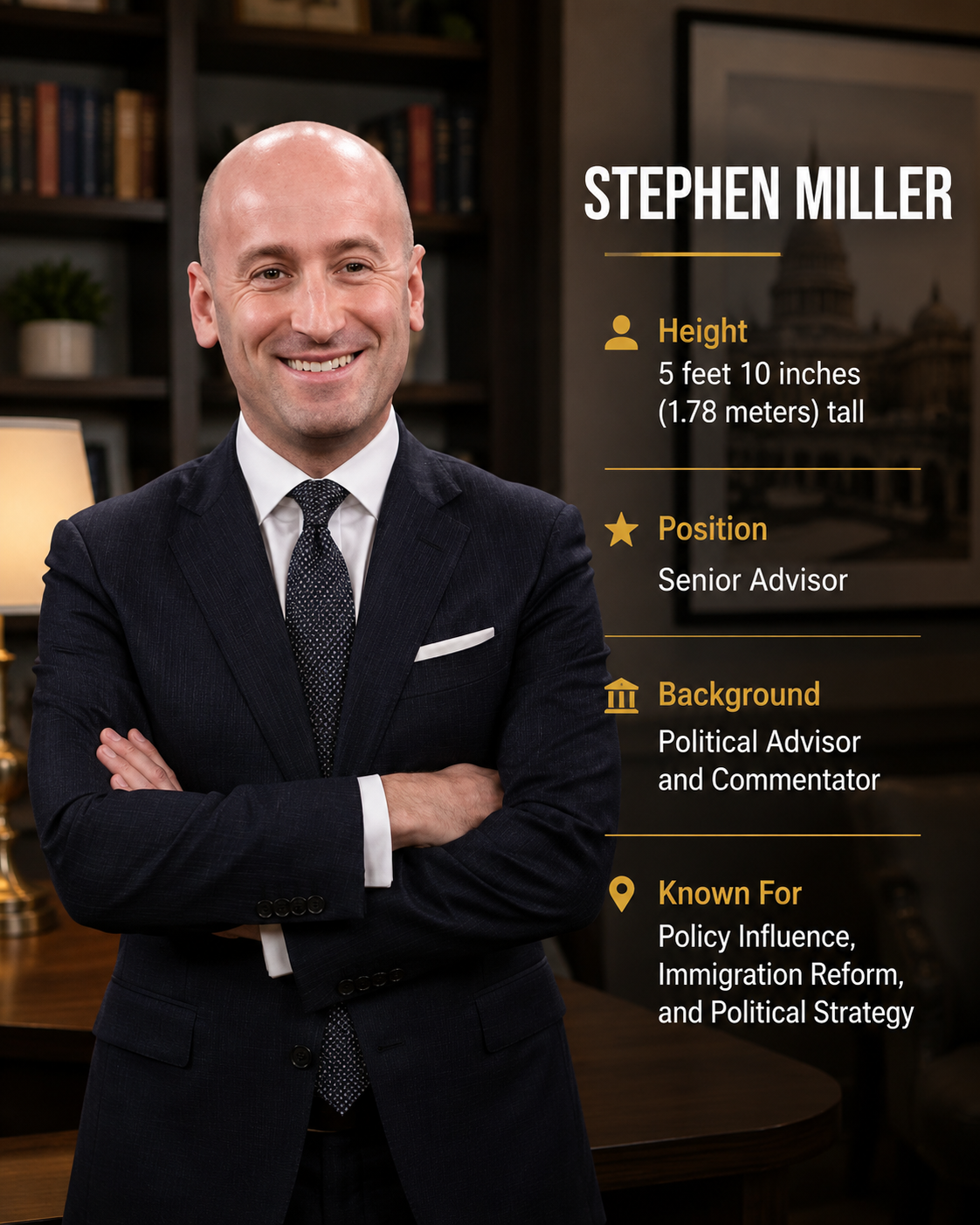
Stephen Miller has emerged as one of the most influential and controversial figures in contemporary American politics—a conservative policy architect whose impact on Trump administration’s immigration policies has fundamentally shaped national discourse and policy direction. As Deputy Chief of Staff for Policy and Homeland Security Advisor in Trump’s second term (2025–present), Miller commands extraordinary influence over domestic policy, immigration enforcement, and increasingly, foreign policy decision-making.
Yet beyond his substantial political influence and contentious policy positions, Miller has become subject of public curiosity regarding his physical appearance, particularly his height. A 2024 exchange between Representative Alexandria Ocasio-Cortez and Miller regarding his stature generated sufficient media attention that Miller felt compelled to publicly confirm his height of 5 feet 10 inches on national television. This relatively minor detail about his physical appearance, amplified through social media and political commentary, reflects broader cultural dynamics wherein even senior government officials’ personal characteristics become subject of public discussion and occasional ridicule.
This article examines both dimensions of Stephen Miller’s public prominence—his substantial and controversial political career as immigration policy architect and “America First” movement figure, and the surprising public interest in his physical appearance, including the height controversy that emerged from social media commentary.
Quick Info
| Detail | Information |
|---|---|
| Full Name | Stephen Miller |
| Height | 5 feet 10 inches (1.78 meters) |
| Current Position | White House Deputy Chief of Staff for Policy and Homeland Security Advisor |
| Administration | Trump’s Second Term (2025–Present) |
| Birth Year | Approximately 1985 |
| Education | Duke University (graduated 2007) |
| Political Ideology | Conservative, “America First” movement |
| Career Start | Congressional staffer (2007+) |
| Initial Congressional Roles | Press Secretary for Michele Bachmann and John Shadegg |
| Key Senate Role | Communications Director for Senator Jeff Sessions |
| Trump 2016 Campaign | Early campaign speechwriter and supporter |
| First Trump Term | Senior Policy Advisor (2017-2021) |
| Post-Trump Business | Founder, America First Legal Foundation (2021) |
| Known For | Immigration policy architect, restrictive border policies |
| Second Term Appointment | January 2025 |
| Height Source | Confirmed on Fox News’ The Ingraham Angle |
| Height Controversy | AOC’s Instagram livestream comments about his appearance |
| Corroboration | Laura Ingraham confirmed height as 5’10”-5’11” |
Early Life and Educational Background
Duke University Education
Stephen Miller graduated from Duke University in 2007, an elite institution indicating strong academic credentials and serious intellectual engagement with political and policy matters. Duke’s rigorous academic environment and Washington-connected alumni networks positioned him well for subsequent entry into political spheres.
His educational background at Duke, combined with his subsequent career trajectory, suggests sustained conservative political ideology developed during formative educational years. Duke’s political science and policy programs likely provided framework for understanding conservative governance and political strategy.
Conservative Ideology Development
While specific details about Miller’s early political awakening aren’t extensively documented, his subsequent career demonstrates committed conservative ideology aligned with restrictive immigration positions and nationalist economic perspectives. His educational experience at Duke likely reinforced conservative intellectual frameworks.
Early Congressional Career
Press Secretary Roles
Following his 2007 Duke graduation, Stephen Miller entered Congressional service as press secretary for Republican Representatives Michele Bachmann and John Shadegg. Press secretary positions, while not typically highest-ranking roles, provide education in Congressional operations, media relations, and legislative processes.
Michele Bachmann, known for her strong conservative positions and Tea Party movement involvement, provided political environment aligned with Miller’s evident ideological commitments. Working for her exposed him to media strategy and political communication at Congressional level.
Communications Director for Senator Jeff Sessions
Miller’s career progressed to role as communications director for Senator Jeff Sessions, a prominent Republican known for his restrictive immigration positions. Sessions, who would later become Trump’s first Attorney General, represented significant figure in anti-immigration political movement.
This role as Sessions’ communications director proved formative for Miller’s eventual prominence. Sessions’ focus on immigration restriction aligned perfectly with Miller’s evident policy interests. The position positioned Miller to develop expertise and prominence in immigration policy debates within Republican circles.
Rise to Prominence: Trump 2016 Campaign
Early Campaign Involvement
Stephen Miller joined Donald Trump’s 2016 presidential campaign early, recognizing opportunity to influence presidential campaign platform on immigration and related policy issues. His early involvement, before Trump’s candidacy was broadly taken seriously, demonstrated ideological commitment to Trump’s nationalist platform.
His position as speechwriter represented significant role, allowing him to craft messaging and articulate campaign positions directly. Rather than merely advising on policy, he shaped how policies were communicated to American voters.
Crafting Key Campaign Speeches
Miller authored significant campaign speeches, most notably Trump’s 2016 Republican National Convention acceptance speech—one of the most important addresses of the campaign. The convention speech represented opportunity to articulate campaign’s central themes and positions to national audience.
His speechwriting demonstrated rhetorical skill and understanding of political messaging that would resonate with Trump’s base. The convention speech, which emphasized nationalist themes and anti-establishment messaging, reflected Miller’s ideological perspective and communication style.
Rally Warm-Up Speaker Role
Beyond behind-the-scenes writing, Miller frequently served as warm-up speaker at Trump rallies during 2016 campaign. This public-facing role demonstrated his capability to energize crowds, communicate policy positions effectively, and command stage presence—capabilities that would serve him well in subsequent television and public advocacy roles.
His willingness to take public speaking role, rather than remaining entirely behind-the-scenes, raised his profile within Trump campaign infrastructure and demonstrated confidence in his ability to represent campaign to supporters directly.
First Trump Term: Senior Policy Advisor and Immigration Architecture
Senior Policy Advisor Role (2017-2021)
When Trump assumed the presidency in 2017, Miller transitioned to role as Senior Policy Advisor—a position providing direct influence over administration’s policy development. Rather than holding Cabinet-level title, his influence exceeded many formal cabinet positions due to his direct access to Trump and his role in policy drafting.
His proximity to Trump and his evident ideological alignment with Trump’s nationalist “America First” platform positioned him as central figure in administration’s policy direction. While other advisors came and went, Miller maintained consistent influence throughout Trump’s first term.
Immigration Policy Architecture
Miller emerged as primary architect of Trump administration’s most restrictive and controversial immigration policies. His influence extended across border security, immigration enforcement, legal immigration levels, and asylum policy—essentially the entirety of immigration policy domain.
His role transcended advisory capacity; he actively drafted executive orders, shaped policy implementation, and directed agency behavior. ICE officials reported to him regarding enforcement priorities and targets. His ideological vision fundamentally shaped how administration approached immigration.
The Muslim Travel Ban (2017)
One of Miller’s first major policy achievements was authoring the 2017 travel ban targeting several Muslim-majority nations. The policy, repeatedly revised to withstand legal challenges, represented signature Trump administration initiative restricting immigration from specific countries based on alleged terrorism concerns.
The travel ban generated significant legal and political controversy. Opponents argued it represented Muslim ban violating constitutional principles of religious non-discrimination. Supporters defended it as national security measure addressing terrorism risks. Miller defended the policy vigorously, becoming public face of its justification.
Zero Tolerance Family Separation (2018)
Perhaps most controversial policy for which Miller bears primary responsibility is the 2018 “zero tolerance” family separation policy at the southern border. The policy mandated criminal prosecution of all border-crossing adults, resulting in separation of children from parents while adults faced prosecution.
The family separation policy generated enormous public outcry, with humanitarian organizations, Congressional Democrats, and even some Republicans expressing outrage at images of separated children and reports of traumatic conditions. Medical professionals documented significant psychological harm to separated children.
Miller defended the policy as necessary deterrent to border crossing, arguing that harsh consequences would discourage unauthorized immigration attempts. The policy remained in place for months despite intense criticism before Trump ultimately reversed it amid sustained pressure.
Border Wall Funding and Construction
Miller championed massive border wall funding as central immigration policy priority. The border wall construction represented signature Trump administration initiative, with Miller advocating vigorously for funding and defending the project against critics questioning its effectiveness and cost.
His advocacy for wall construction shaped administration’s budget priorities, with significant resources allocated to wall construction despite Congressional opposition from Democrats and concerns from some Republicans about cost and effectiveness.
ICE Enforcement Targets
Under Miller’s direction, Immigration and Customs Enforcement (ICE) officials received specific arrest targets, including ambitious goals of 3,000 migrant arrests per day. These numerical targets drove enforcement operations, with agency officials evaluated based on arrest numbers.
The numerical targets approach to immigration enforcement, characteristic of Miller’s policy methodology, represented shift from targeting individuals with serious criminal histories toward broader enforcement sweeping up individuals with minimal or no criminal records.
End of Birthright Citizenship Advocacy
Miller has championed elimination of birthright citizenship—the constitutional principle that children born in the United States automatically receive citizenship regardless of parents’ immigration status. His advocacy for ending birthright citizenship represents fundamental constitutional change altering citizenship foundations.
The birthright citizenship position places Miller at ideological extremes of even restrictive immigration positions. Most mainstream politicians have avoided directly challenging birthright citizenship, recognizing the enormous scope of constitutional change required and the potential political backlash.
America First Legal Foundation and Private Sector Years
Post-2020 Career Transition
Following Trump’s 2020 electoral defeat, Stephen Miller transitioned to private sector, founding the America First Legal Foundation in 2021. Rather than stepping away from politics, he created legal organization continuing to advance his policy agenda through courts and legal advocacy.
The America First Legal Foundation represented continuation of Miller’s political work through different mechanism. Rather than government positions, he utilized legal advocacy and court challenges to oppose Biden administration policies and advance conservative legal positions.
Legal Strategy and Court Challenges
The America First Legal Foundation employed legal strategy challenging Biden administration policies deemed inconsistent with constitutional principles or statutory law. The organization filed suits opposing immigration policies, environmental regulations, and other Biden initiatives.
This legal advocacy approach allowed Miller to maintain influence and prominence despite absence from government. By targeting specific Biden policies through courts, he kept immigration and related policy issues prominent in political discourse.
Influence Beyond Government
Through America First Legal Foundation and related media appearances, Miller maintained significant political influence despite lack of government position. His commentary on immigration and policy issues continued appearing on conservative media, maintaining his prominence within conservative movement.
Second Trump Term: Expanded Authority and Influence
Deputy Chief of Staff for Policy and Homeland Security Advisor
In Trump’s second term beginning January 2025, Miller’s authority expanded substantially. His appointment as Deputy Chief of Staff for Policy and Homeland Security Advisor positioned him as one of administration’s most powerful figures, with influence over both domestic and increasingly foreign policy.
The Deputy Chief of Staff position, combined with Homeland Security Advisor role, gave Miller unusual breadth of authority. Rather than limiting his influence to immigration, his portfolio expanded to encompass all domestic policy development and executive order drafting.
Expanded Domestic Policy Authority
Miller’s responsibility for domestic policy development means he shapes how administration approaches economic policy, regulatory policy, and social policy issues. His ideological perspective influences policy development across government, not merely immigration matters.
His influence over executive order drafting means he largely determines how administration translates campaign promises and policy goals into actual government action. Agencies must implement orders reflecting his policy vision.
Capitol Hill Liaison Role
Miller serves as critical liaison between White House and Congressional Republicans. This role requires skills in persuasion, negotiation, and understanding of Congressional dynamics—capabilities demonstrating his evolution from pure ideological advisor to political operator managing complex relationships.
His Congressional liaison role positions him to advocate for administration policies, explain policies to skeptical Republicans, and coordinate with Congressional leaders on legislative agenda.
Foreign Policy Expansion
Notably, Miller’s influence has expanded into foreign policy—traditionally handled by Secretary of State and Defense Secretary. His reported involvement in military strike planning in the Middle East and assertive positions on resource-rich territories represents significant expansion of his portfolio.
This foreign policy expansion reflects Trump’s tendency to empower trusted advisors across traditional departmental boundaries. Rather than limiting Miller to domestic policy, Trump has expanded his authority to include international affairs, demonstrating extraordinary trust.
Policy Positions and Ideological Framework
Restrictive Immigration Philosophy
Miller’s core ideological position emphasizes restriction of immigration into United States. Rather than viewing immigration as potentially beneficial or neutral force, he views it as phenomenon requiring severe limitation and control.
His philosophical perspective on immigration differs substantially from immigration advocates and mainstream economists who highlight immigrants’ contributions to economy and society. Miller’s framework emphasizes immigration’s supposed negative impacts on wages, jobs, and social cohesion.
Nationalist “America First” Ideology
Miller aligns himself with Trump’s “America First” movement—ideological framework prioritizing American interests in foreign policy, trade, and immigration policy. The America First perspective emphasizes national sovereignty and skepticism of international institutions and agreements.
This nationalist ideology shapes Miller’s positions across policy domains. Whether discussing immigration, trade, or foreign policy, his consistent principle emphasizes advancing American interests as he defines them.
Legal Strategy and Constitutional Interpretation
Miller’s approach to policy implementation emphasizes legal strategies and executive authority to accomplish policy goals. His understanding that courts interpret Constitutional and statutory limits on executive action has shaped his strategy of carefully crafting executive orders to withstand legal challenge.
His founding of America First Legal Foundation reflects understanding that legal strategy represents crucial mechanism for advancing policy goals in American system with separated powers and independent judiciary.
Aggressive Enforcement Philosophy
Miller’s policy approach emphasizes aggressive enforcement and numerical targets. Rather than viewing enforcement as targeted response to serious violations, his approach emphasizes broad enforcement with numerical targets driving operation scale.
His direction of ICE to pursue 3,000 arrests per day represented enforcement approach prioritizing volume over selectivity. This enforcement philosophy contrasts with approaches emphasizing criminal history and threat assessment in enforcement prioritization.
The Height Controversy
Alexandria Ocasio-Cortez Instagram Comment
The height controversy emerged when Representative Alexandria Ocasio-Cortez, commenting on Miller during an Instagram livestream, mockingly guessed that he appeared to be approximately 4 feet 10 inches tall. The comment represented humorous jab at Miller’s appearance, suggesting he was shorter than commonly assumed.
AOC’s comment, while seemingly minor, reflected broader pattern of political figures’ appearances becoming subject of public commentary and mockery. Her comment, delivered to substantial Instagram audience, generated sufficient attention that it circulated through media and social media.
Stephen Miller’s Fox News Response
Rather than ignoring the comment, Stephen Miller chose to address it directly during an appearance on Fox News’ “The Ingraham Angle.” During the interview, he publicly confirmed his actual height as 5 feet 10 inches—substantially taller than AOC’s mocking guess.
His decision to publicly address the height comment demonstrated several things: willingness to engage with criticism, understanding that the comment had gained sufficient attention to warrant response, and confidence in addressing the matter directly with media and public.
Laura Ingraham Corroboration
Laura Ingraham, host of “The Ingraham Angle” and longtime acquaintance of Miller, corroborated his height claim during the same interview. Ingraham noted she has known Miller for approximately two decades and confirmed he stands approximately 5 feet 10 inches to 5 feet 11 inches tall.
Ingraham’s corroboration added credibility to Miller’s claim, as her long personal relationship with him provided basis for her assessment. Her confirmation essentially ended the height controversy, as two credible sources on national television had confirmed his actual height.
Cultural Significance of the Controversy
The height controversy, while seemingly trivial, reflects broader dynamics of contemporary politics wherein even senior government officials’ personal characteristics become subject of public commentary and media attention. AOC’s comment, made in lighthearted spirit, generated sufficient attention that Miller felt compelled to publicly address it.
The incident also illustrates how social media comments from prominent political figures can generate disproportionate attention and become subject of media coverage. AOC’s offhand Instagram comment reached audiences far beyond her direct followers through news coverage and social media sharing.
Public Controversy and Criticism
Immigration Policy Criticism
Miller’s immigration policies have generated sustained criticism from human rights organizations, immigration advocates, and humanitarian groups. The family separation policy particularly generated intense criticism regarding its humanitarian impacts on children and families.
Criticism extends beyond humanitarian concerns to questions about policy effectiveness. Research suggests restrictive immigration policies Miller has championed have limited actual impact on unauthorized immigration, raising questions about whether policies achieve stated objectives.
Characterization and Controversial Statements
Miller has been characterized as extremist by critics, who point to his advocacy for elimination of birthright citizenship and other positions considered outside mainstream policy debate. Some critics have noted statements perceived as controversial or inflammatory.
Miller has dismissed such characterizations, arguing that immigration restriction represents legitimate policy position and that critics misrepresent his actual positions.
Ongoing Controversy in Second Term
In Trump’s second term, Miller’s expanded authority has maintained him as subject of substantial controversy. Democratic critics have expressed alarm at his influence over policy, while immigration advocates have renewed opposition to anticipated restrictive policies.
Frequently Asked Questions
Personal Information
Q: How tall is Stephen Miller?
A: Stephen Miller is 5 feet 10 inches (1.78 meters) tall. He publicly confirmed this height during a Fox News interview on “The Ingraham Angle.”
Q: What prompted Stephen Miller to publicly discuss his height?
A: Representative Alexandria Ocasio-Cortez mockingly guessed on Instagram that Miller was about 4 feet 10 inches tall. Miller addressed the comment directly during a Fox News appearance, confirming his actual height.
Q: Who confirmed Stephen Miller’s height?
A: Laura Ingraham, host of “The Ingraham Angle,” corroborated Miller’s height claim, noting she has known him for approximately two decades and confirmed he stands 5’10” to 5’11” tall.
Q: When did the height controversy occur?
A: The height controversy emerged in 2024 when AOC made the mocking comment about Miller’s appearance during an Instagram livestream.
Career and Position
Q: What is Stephen Miller’s current position?
A: Stephen Miller serves as Deputy Chief of Staff for Policy and Homeland Security Advisor in Trump’s second term, beginning January 2025.
Q: What was Stephen Miller’s role in Trump’s first term?
A: He served as Senior Policy Advisor, playing central role in developing and implementing immigration policies.
Q: Where did Stephen Miller work before joining Trump’s campaign?
A: He worked as press secretary for Representatives Michele Bachmann and John Shadegg, and as communications director for Senator Jeff Sessions.
Q: What is America First Legal Foundation?
A: America First Legal Foundation is organization founded by Miller in 2021 following Trump’s 2020 election defeat. It pursues legal challenges to Biden administration policies.
Q: What are Stephen Miller’s major policy accomplishments?
A: Miller’s major policies include the 2017 Muslim travel ban, the 2018 family separation policy, border wall funding and construction, ICE enforcement targets, and advocacy for eliminating birthright citizenship.
Education
Q: Where did Stephen Miller attend college?
A: Stephen Miller graduated from Duke University in 2007.
Q: What did Stephen Miller study at Duke?
A: While specific major isn’t extensively documented, he clearly studied political science or related field given his subsequent political career.
Policy Positions
Q: What is Stephen Miller’s immigration philosophy?
A: Miller advocates for restrictive immigration policies, including eliminating birthright citizenship, aggressive border enforcement, and severe limitation on immigration levels.
Q: Why is Stephen Miller controversial?
A: Miller is controversial for his immigration policies, particularly the family separation policy, and for his advocacy of positions like eliminating birthright citizenship that many consider extreme.
Q: Has Stephen Miller faced criticism for specific policies?
A: Yes, particularly the family separation policy, which generated humanitarian concerns about impacts on children and families.
Q: What is Miller’s “America First” philosophy?
A: Miller aligns with Trump’s “America First” ideology emphasizing American interests in foreign policy, trade, and immigration, and emphasizing national sovereignty.
Trump Administration Roles
Q: When did Stephen Miller join Trump’s campaign?
A: Miller joined Trump’s 2016 presidential campaign early, before Trump’s candidacy was broadly taken seriously.
Q: What was Stephen Miller’s role during Trump’s 2016 campaign?
A: He served as speechwriter and warm-up speaker, authoring key speeches including Trump’s Republican National Convention acceptance speech.
Q: How did Stephen Miller rise to prominence?
A: Miller rose to prominence through his central role in developing and defending Trump administration’s restrictive immigration policies during the first term.
Q: What expanded in Stephen Miller’s second term authority?
A: In the second term, Miller’s authority expanded from immigration focus to encompassing all domestic policy development and increasingly foreign policy involvement.
Conclusion
Stephen Miller represents one of contemporary American politics’ most influential and controversial figures—a conservative policy architect whose immigration policies have fundamentally shaped Trump administration direction and national immigration discourse. From his early Congressional career through his role as Senior Policy Advisor in Trump’s first term to his current position as Deputy Chief of Staff for Policy and Homeland Security Advisor in the second term, Miller has exercised extraordinary influence over American governance.
His policy accomplishments—the Muslim travel ban, family separation policy, border wall construction, ICE enforcement targets, and ongoing advocacy for eliminating birthright citizenship—represent signature conservative immigration agenda that has generated sustained controversy regarding both effectiveness and humanitarian impacts.
Beyond his substantial political influence, Miller’s prominence extends to unexpected public interest regarding his physical appearance, particularly the 2024 height controversy generated by AOC’s Instagram comment. His decision to publicly address the comment through Fox News, combined with Laura Ingraham’s corroboration, confirmed his height at 5 feet 10 inches.
The height controversy, while seemingly minor compared to his policy influence, illustrates contemporary political dynamics wherein senior government officials’ personal characteristics become subject of public commentary and media attention. The incident demonstrates how social media comments from prominent political figures can generate disproportionate media coverage and public interest.
Miller’s trajectory from Congressional staffer to White House influencer reflects his sustained ideological commitment to restrictive immigration policies and nationalist “America First” philosophy. Whether one views his policies as important security measures or as extreme positions violating humanitarian principles, Miller’s influence on American immigration policy and broader governance remains undeniable.
In Trump’s second term, Miller’s expanded authority over domestic and increasingly foreign policy represents continued elevation of his influence. His positions on various policy issues continue shaping Trump administration direction and generating controversy among critics and supporters alike.
Stephen Miller’s significance in contemporary American politics ultimately rests on his substantial policy influence rather than physical characteristics, despite public curiosity about his height. His immigration policies and their implementation have affected millions of people, generated sustained political debate, and reshaped American immigration law and practice in significant ways—accomplishments that far exceed public interest in the height of the 5’10” conservative policy architect.