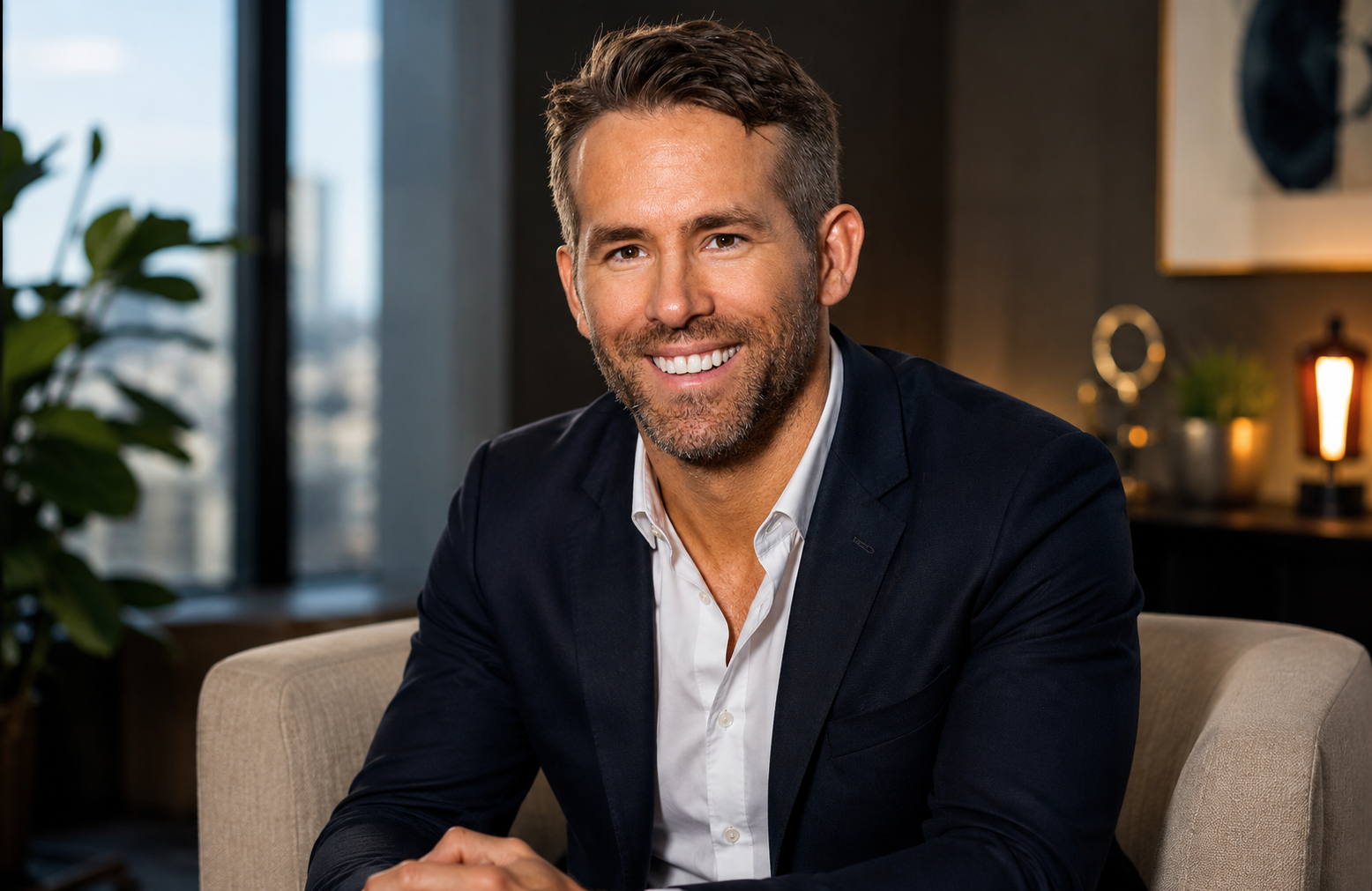
Who is Ryan Reynolds?
Ryan Reynolds represents a unique phenomenon in contemporary entertainment—a successful actor whose business ventures and entrepreneurial acumen have generated wealth exceeding his film industry earnings. With an estimated net worth of $350 million, Reynolds exemplifies the modern entertainment executive who treats acting as one component of a diversified wealth-building strategy rather than the primary focus.
Reynolds’ ascent from Canadian television actor to global superstar combines exceptional comedic timing, strategic career choices, and most importantly, sophisticated business development capabilities. Unlike many high-profile actors who focus exclusively on film roles, Reynolds recognized early that entertainment industry wealth concentrates among entrepreneurs and business owners rather than performers alone. This strategic insight, coupled with execution excellence, has positioned him among entertainment’s wealthiest individuals.
The distinction between Reynolds’ wealth-building approach and typical actor career paths deserves emphasis. While many actors command substantial salaries—$20-30 million per film—they receive employment income subject to taxation and provide no lasting ownership or compounding returns. Reynolds, conversely, structures major deals to include equity stakes, ownership positions, and ongoing royalties. This fundamental difference in business philosophy explains why his net worth substantially exceeds peers with comparable or higher individual film salaries.
Reynolds’ cultural impact extends beyond traditional entertainment metrics. His marketing genius and sharp comedic sensibility have transformed his business ventures into cultural phenomena. Aviation American Gin achieved market dominance not through conventional advertising but through Reynolds’ authentic brand integration and memorable marketing campaigns. Similarly, his involvement with Wrexham A.F.C. has elevated a struggling Welsh football club into global media phenomenon. These successes reflect genuine business acumen rather than celebrity name leverage.
Quick Info: Ryan Reynolds
| Category | Details |
|---|---|
| Current Net Worth | $350 million (individual) |
| Combined Net Worth with Blake Lively | ~$380 million |
| Full Name | Ryan Rodney Reynolds |
| Date of Birth | October 23, 1976 |
| Birthplace | Vancouver, British Columbia, Canada |
| Nationality | Canadian-American |
| Spouse | Blake Lively (married since 2012) |
| Children | Four (James, Inez, Betty, and Olin) |
| Primary Income Sources | Film acting, TV production, business ventures, equity stakes |
| Typical Movie Salary | $20 million+ per film |
| Major Film Franchise | Deadpool (highest-grossing R-rated film franchise) |
| Key Business Ventures | Mint Mobile, Aviation American Gin, Wrexham A.F.C., Maximum Effort |
| Notable Business Exits | Aviation American Gin sale ($610 million), Mint Mobile acquisition ($1.35 billion) |
| Production Company | Maximum Effort Productions |
| Sports Ownership | Wrexham A.F.C. co-owner with Rob McElhenney |
Early Life and the Path to Stardom
Growing Up in Vancouver, British Columbia
Ryan Rodney Reynolds was born on October 23, 1976, in Vancouver, British Columbia, to parents Jim Reynolds (a wholesaler and food distributor) and Tammy Reynolds (a retail clerk). Growing up in Vancouver during the 1980s positioned Reynolds in Canada’s entertainment industry capital, though his initial aspirations centered on more traditional pursuits. His childhood was relatively ordinary—suburban, working-class family with values emphasizing education and responsibility.
Vancouver’s entertainment industry infrastructure, while less developed than Los Angeles, provided emerging opportunities for young actors. Reynolds’ early exposure to entertainment culture through Vancouver’s growing television and film production sector sparked interest in acting during adolescence. The city’s relatively accessible entertainment industry compared to concentrated Hollywood competition provided opportunities for developing talent to access auditions and roles unavailable in other markets.
Reynolds’ family, while not wealthy, valued education and encouraged professional pursuits. His upbringing emphasized work ethic and responsibility—values that would characterize his later business approach. Unlike many actors who grew up in entertainment-adjacent families, Reynolds entered the industry as an outsider, bringing fresh perspective unencumbered by family connections or expectations.
Early Acting Career and Television Success
Reynolds began his professional acting career in 1991 at age fifteen, joining the Canadian soap opera “Hillside” (distributed internationally as “Fifteen”). The television series provided essential experience and exposure, allowing Reynolds to develop craft while building industry connections. His early work emphasized dramatic acting, establishing him as a serious performer rather than comedic talent, a characterization that would shift dramatically in subsequent career phases.
Following “Hillside,” Reynolds transitioned to American television with a role in the sitcom “Two Guys, a Girl and a Pizza Place” (1998-2001), which achieved moderate success. The sitcom exposure expanded his visibility in American markets while allowing him to develop comedic timing that distinguished his later performances. The ensemble cast dynamic and comedic material proved formative for Reynolds’ evolving entertainment identity.
However, Reynolds’ early film career proved less successful. He appeared in numerous movies throughout the 1990s and 2000s—including romantic comedies and action films—without achieving major stardom. These roles, while generating income and experience, positioned Reynolds as capable but unexceptional actor unlikely to achieve A-list status. The conventional trajectory suggested Reynolds would become reliable supporting actor rather than bankable star.
The Van Wilder Breakthrough and Career Evolution
Reynolds’ career gained momentum with “National Lampoon’s Van Wilder” (2002), a college comedy that achieved cult status despite modest theatrical performance. The film’s success reflected Reynolds’ exceptional comedic timing and likability—qualities increasingly valued in commercial entertainment. “Van Wilder” established Reynolds as comedic talent capable of anchoring films, differentiating him from earlier dramatic roles.
However, Reynolds’ subsequent film career remained inconsistent through the 2000s. He appeared in successful films like “The Proposal” (2009), where his chemistry with Sandra Bullock impressed audiences, and “Buried” (2010), a challenging single-location thriller demonstrating dramatic range. Yet he also endured significant box office failures, most notably “Green Lantern” (2011), a superhero film widely regarded as one of cinema’s worst. These mixed results reinforced uncertainty about Reynolds’ star potential.
The repeated failures and modest successes should have derailed Reynolds’ career trajectory, yet he persisted. This resilience, combined with strategic thinking about repositioning and reinvention, would prove crucial. Rather than accepting supporting roles in A-list productions, Reynolds maintained confidence in his talent and viability while actively developing business opportunities outside traditional acting structures.
The Deadpool Revolution: Career Transformation
Green Lantern Failure and Strategic Repositioning
Before achieving superstardom, Reynolds experienced significant professional failure. “Green Lantern” (2011), despite substantial production budgets and studio investment, became a critical and commercial disaster. Reynolds, while certainly not solely responsible, was prominently featured in promotional materials and interviews. The failure was painful professionally but ultimately proved beneficial, forcing career recalibration and opening space for different opportunities.
Reynolds’ response to “Green Lantern” failure demonstrated crucial psychological and strategic qualities. Rather than accepting reduced opportunities or retreating to supporting roles, he remained confident in his abilities while fundamentally reconsidering career direction. The failure created opportunity for reinvention—a fresh start where previous successes and failures held less power over future perception.
During this period, Reynolds began seriously considering business development beyond traditional acting. He observed that entertainment industry’s most successful figures often combined performance with business ownership. The realization that film salaries, no matter how substantial, provided limited wealth compared to ownership stakes fundamentally shifted his career philosophy. This strategic insight would prove transformative.
The Deadpool Phenomenon and Game-Changing Success
Reynolds’ career transformation came through “Deadpool” (2016), an R-rated superhero film based on Marvel Comics character. The film represented significant risk—studios rarely invested heavily in R-rated superhero content targeting mature audiences rather than mainstream blockbuster demographics. Reynolds’ involvement, while not guaranteeing success, demonstrated faith in the project and willingness to take risks divergent from conventional superhero film formulas.
The film’s success proved extraordinary. “Deadpool” earned over $760 million globally on modest budgets, becoming the highest-grossing R-rated film at that time and demonstrating market demand for adult-oriented superhero content. Critical reception praised Reynolds’ performance, wit, and screen presence—exactly the qualities his earlier films had insufficiently showcased. The film’s success positioned Reynolds as bankable star capable of anchoring major franchises.
However, Reynolds’ most significant contribution to “Deadpool’s” success extended beyond performance. He actively participated in marketing, promotional campaigns, and strategic decision-making through his production company, Maximum Effort. His humor, authenticity, and understanding of target audiences shaped the film’s marketing approach, which emphasized irreverent wit and self-referential comedy. This integrated approach—combining performance with business strategy and marketing expertise—distinguished Reynolds from typical actors.
“Deadpool’s” massive success immediately elevated Reynolds’ market value. Studios recognized him as bankable star commanding premium compensation. More importantly, his demonstrated marketing acumen attracted business partners seeking his involvement not merely for celebrity but for genuine commercial expertise. The film transformed Reynolds’ professional identity from actor seeking roles to business partner with proven value across entertainment categories.
The Deadpool Franchise and Sequels
The “Deadpool” franchise’s continued success cemented Reynolds’ superstar status. “Deadpool 2” (2018) achieved comparable commercial success, earning over $700 million globally and further validating the franchise model. “Deadpool & Wolverine” (2024), featuring Hugh Jackman’s return as Wolverine, became the highest-grossing R-rated film of all time, demonstrating sustained franchise appeal and Reynolds’ continued drawing power.
Reynolds’ involvement extended throughout the franchise, encompassing not merely acting but creative decisions, marketing strategy, and production oversight through Maximum Effort. His fingerprints appeared throughout films—in dialogue, marketing campaigns, promotional materials, and strategic positioning. This comprehensive involvement distinguished him from actors merely performing scripted roles, positioning him as creative force and business executive.
The Deadpool franchise’s success generated enormous income for Reynolds. At contemporary compensation levels, each film likely provided $20-30 million in direct compensation. However, Reynolds’ involvement in ownership structures and profit participation arrangements meant total earnings from franchise films exceeded direct salary. Additionally, the franchise’s success elevated his market value for subsequent projects, enabling higher compensation and better terms.
The Business Empire: Entrepreneurial Ventures and Wealth Creation
Aviation American Gin: The Spirits Success Story
While acting remains prominent in Reynolds’ career, his business ventures have generated comparable or superior wealth. In 2018, Reynolds acquired an ownership stake in Aviation American Gin, a spirits brand competing in crowded premium gin market. The acquisition represented significant business opportunity—the spirits industry generates enormous profit margins, particularly for premium brands, and audience building among gin-drinking demographics seemed manageable given Reynolds’ marketing genius.
Reynolds’ involvement extended beyond financial investment to direct creative participation. Through Maximum Effort, his production and marketing agency, Reynolds developed imaginative promotional campaigns emphasizing humor and authenticity. Television commercials, social media content, and public appearances showcased Reynolds’ comedic timing while integrating gin consumption naturally into entertainment. The approach contrasted sharply with conventional spirits advertising, resonating with audiences and driving sales growth.
Aviation American Gin’s transformation proved remarkable. Within years of Reynolds’ involvement, the brand achieved market leadership among American gin brands, achieving status as one of spirits industry’s fastest-growing premium brands. The success reflected combination of quality product, premium positioning, and Reynolds’ exceptional marketing execution. The brand became culturally synonymous with Reynolds himself, with consumers associating gin consumption with his distinctive humor and style.
The business venture’s value escalated dramatically as sales and market position strengthened. In 2020, British spirits conglomerate Diageo acquired Aviation American Gin, with valuations suggesting Reynolds’ equity stake generated approximately $610 million return. The sale represented one of entertainment industry’s most successful business exits, demonstrating that spirits ventures could generate returns exceeding most film projects. For Reynolds, the Aviation investment proved far more profitable than alternative uses of equivalent capital.
Mint Mobile: The Wireless Disruption
In 2018, the same year Reynolds invested in Aviation American Gin, he acquired an ownership stake in Mint Mobile, a wireless carrier offering discount plans challenging traditional carriers’ premium pricing. The telecommunications industry represented entirely different terrain from spirits—technical infrastructure, regulatory complexity, and capital requirements far exceeded consumer goods businesses. Yet Reynolds recognized disruption opportunity and business potential justifying involvement despite unfamiliar industry dynamics.
Reynolds’ role at Mint Mobile combined financial investment with creative marketing leadership. Through Maximum Effort, he developed marketing campaigns emphasizing value proposition and challenging industry incumbents’ pricing practices. Television commercials and promotional content showcased Reynolds’ humor while communicating core business message—significant savings through alternative wireless provider. The campaigns proved highly effective, attracting customers and generating brand recognition rivaling carriers with vastly larger marketing budgets.
Mint Mobile achieved remarkable growth during Reynolds’ ownership, expanding customer base and market presence substantially. The success reflected combination of genuine business value—lower prices than competitors—and Reynolds’ marketing excellence in communicating that value to relevant audiences. The company’s growth trajectory attracted acquisition interest from major telecommunications companies seeking low-cost customer acquisition and market share expansion.
T-Mobile, the third-largest American wireless carrier, acquired Mint Mobile in 2023 for approximately $1.35 billion. Reynolds’ estimated 25% ownership stake generated roughly $330-340 million return—a single transaction generating wealth comparable to his entire previous lifetime career earnings. The acquisition demonstrated that telecommunications ventures, despite industry complexity, could generate extraordinary returns through strategic execution and marketing excellence.
The combined returns from Aviation American Gin and Mint Mobile—approximately $940 million—represent transformative wealth accumulation exceeding typical actor compensation across entire career. These two business ventures alone likely contributed more to Reynolds’ net worth than all film earnings combined, illustrating fundamental distinction between performance compensation and business ownership.
Maximum Effort: The Production and Marketing Engine
Beyond specific business ventures, Reynolds established Maximum Effort as integrated production company and marketing agency. Operating as holding company combining film production, television production, and marketing services, Maximum Effort enables Reynolds to participate in multiple business categories while maintaining control over creative output and strategic direction.
Maximum Effort’s structure allows Reynolds to apply marketing expertise across multiple client relationships. The company handles promotional campaigns for films, produces original content, and executes marketing strategies for other brands and ventures. This diversified business model generates multiple revenue streams—production fees, equity participation in projects, and consulting revenue from marketing services.
The company’s success reflects Reynolds’ genuine understanding of modern marketing and audience engagement. Rather than treating marketing as separate function from content creation, Maximum Effort integrates promotional strategy into creative development. This comprehensive approach enables distinctive positioning and audience connection that conventional approaches struggle to achieve.
Maximum Effort’s operations extend internationally, with film and television production across multiple jurisdictions. The production company capability enables Reynolds to participate in creative decisions and profit-sharing arrangements rather than accepting fixed compensation for performances. Producing projects alongside acting compensation generates additional revenue layers and creative control.
Wrexham A.F.C.: Sports Ownership and Global Impact
In 2020, Reynolds and actor Rob McElhenney acquired the Welsh football club Wrexham A.F.C., an historic institution struggling with financial difficulties and sporting underperformance. The acquisition represented unusual venture for Reynolds—sports ownership rarely provides meaningful financial returns and typically requires significant capital commitment without guaranteed profitability. Yet the business offered marketing opportunities and cultural impact appealing to Reynolds’ creative instincts.
Reynolds and McElhenney’s ownership prioritized both genuine sporting improvement and entertainment value. The duo invested in player acquisitions, coaching staff, and facility improvements while simultaneously documenting their ownership journey for entertainment purposes. This integrated approach—combining authentic business operations with entertainment documentation—proved highly successful.
The documentary series “Welcome to Wrexham” premiered on Hulu/FX in 2022, generating enormous viewership and critical acclaim. The series, which won Emmy Awards, depicted the ownership experience authentically while entertaining audiences through Reynolds’ and McElhenney’s personalities and humor. The documentaries transformed Wrexham from obscure Welsh club into global phenomenon attracting international attention and investment.
Wrexham A.F.C.’s transformation proved substantial. The club achieved promotion to the National League (English football’s fifth tier) in 2023, a significant sporting achievement after years of lower-tier existence. The promotion reflected both operational investment and community engagement improvements. Additionally, Wrexham merchandise sales, sponsorship deals, and broadcasting agreements increased dramatically following ownership transition and documentary success.
While Wrexham A.F.C. may not generate immediate financial returns matching spirits or wireless ventures, the ownership position offers long-term appreciation potential. As the club develops and achieves further sporting success, valuation likely increases substantially. Additionally, the ongoing documentary and entertainment value provides revenue streams independent of sporting performance. The venture represents strategic investment combining financial potential with cultural impact and entertainment opportunity.
Acting Career: Blockbuster Films and Compensation
Film Salaries and Compensation Structure
While business ventures represent Reynolds’ most significant wealth sources, his acting career generates substantial income. Contemporary compensation for major Hollywood films ranges from $15-30 million for established stars, with top-tier talent commanding higher amounts. Reynolds, as bankable star with proven commercial appeal, commands upper-tier compensation reflecting his market value.
Films like “Deadpool” sequels, “Free Guy,” and other major projects likely generated $20 million or more in direct compensation. Additionally, Reynolds negotiates profit-sharing arrangements, backend participation, and other compensation structures providing ongoing returns beyond initial salaries. A single major film might generate $25-35 million including profit participation, compared to $20 million salary alone.
Reynolds’ film compensation has increased substantially over his career. Early films generated modest salaries—$1-5 million for supporting roles or lead positions in smaller productions. “Deadpool’s” success elevated market value dramatically, enabling negotiation of premium compensation reflecting his commercial importance. Current negotiations likely position him among Hollywood’s highest-paid actors for major productions.
Major Films and Commercial Performance
Reynolds’ filmography beyond Deadpool includes several significant commercial and critical successes. “The Proposal” (2009) earned over $300 million globally and showcased his romantic comedy capabilities. “Free Guy” (2021) became one of pandemic-era’s most successful films, earning over $320 million globally. “Detective Pikachu” (2019) generated over $430 million globally through intellectual property popularity and Reynolds’ comedic performance.
“The Adam Project” (2022) reached massive audiences through Netflix platform, though streaming films generate different compensation structures than theatrical releases. These successes, while generating substantial income, often receive less compensation prominence than Deadpool films due to lower individual film salaries (though additional compensation through streaming services and international markets applies).
Reynolds’ acting career demonstrates ability to anchor diverse film genres successfully. Beyond action-oriented Deadpool films, he has excelled in romantic comedies, adventure films, and animated productions. This versatility maintains career longevity and enables continued high-profile roles as aging processes or franchise fatigue affects specific categories.
Acting Production and Participation
Beyond performing, Reynolds participates in film production through Maximum Effort and other arrangements. Producing films generates additional compensation through production fees and profit participation, layering revenue beyond acting salaries. “Free Guy” and other projects credit Reynolds as producer, securing additional financial participation and creative influence.
Production participation reflects Reynolds’ sophisticated approach to entertainment industry economics. Rather than accepting acting compensation alone, he structures deals including production roles, creative decision-making authority, and profit participation. These arrangements dramatically increase total compensation while maintaining creative control.
Combined Family Wealth and Partnership with Blake Lively
Blake Lively’s Separate Fortune
Reynolds’ spouse, Blake Lively, represents accomplished entertainer with independent wealth and career success. Lively, best known for starring roles in television series “Gossip Girl” and films including the “Sisterhood of the Traveling Pants” franchise, has generated estimated net worth around $30 million through acting, endorsements, and business ventures. Her independent wealth and career success distinguish the Reynolds-Lively partnership from typical celebrity marriages where one spouse dominates financially.
Lively’s acting career, while less commercially prominent than Reynolds’, has generated significant earnings through major roles and endorsements. Her involvement in “Gossip Girl,” which achieved cultural phenomenon status, provided lasting residual income through streaming availability and merchandise. Film roles in successful franchises generated substantial salaries, though her career trajectory differs from Reynolds’ blockbuster focus.
Beyond performance, Lively has developed brand partnerships and business relationships. Her involvement with fashion brands, beauty products, and other endorsements has generated additional income and wealth. The combination of acting earnings, endorsements, and prudent financial management has accumulated her $30 million estimated net worth independent of Reynolds’ ventures.
Combined Household Economics
The Reynolds-Lively household represents one of entertainment industry’s wealthiest partnerships with combined net worth approximately $380 million. This concentration of wealth and entertainment success creates unique family dynamics and financial capabilities unavailable to single-income households regardless of earnings magnitude.
Combined wealth enables investment opportunities, real estate acquisitions, and philanthropic activities at scales unavailable to typical households. The family has invested in substantial real estate holdings in prime locations including New York and Los Angeles, accumulated valuable art collections, and maintained diverse investment portfolios. Additionally, combined resources enable significant philanthropic commitments, with the couple supporting various charitable causes and social initiatives.
The partnership also enables professional collaboration and mutual support. While Reynolds and Lively have not starred in films together, they have participated in each other’s professional endeavors through production company collaboration and strategic business advice. Their combined entertainment industry expertise and business acumen enable sophisticated decision-making across ventures.
Strategic Business Philosophy and Wealth Multiplication
Equity Over Income: The Ownership Advantage
Reynolds’ most important business principle involves prioritizing equity stakes and ownership positions over direct compensation. While many actors accept film salaries—employment income subject to taxation and providing no lasting value—Reynolds structures deals to include ownership stakes, profit participation, and ongoing royalties. This fundamental philosophy distinguishes his wealth accumulation from typical entertainment industry earnings.
The Aviation American Gin and Mint Mobile exits demonstrate equity ownership’s superior returns. Rather than accepting $5-10 million consulting fees for marketing assistance, Reynolds invested capital and took equity stakes. When businesses succeeded and sold at major valuations, his equity stakes generated returns dwarfing alternative compensation structures. The principle extends throughout his career—prioritizing ownership over employment defines his business approach.
This ownership philosophy requires different thinking than typical employment-focused careers. Instead of maximizing immediate income, Reynolds evaluates investments based on long-term appreciation potential and compounding returns. The approach involves accepting potentially lower current compensation for unlimited upside, a strategy requiring confidence in business judgment and patience with uncertain timelines.
Marketing Excellence as Competitive Advantage
Reynolds has demonstrated exceptional marketing talent across ventures. Aviation American Gin’s market success, Mint Mobile’s customer acquisition, and Deadpool franchise’s promotional dominance reflect his genuine understanding of modern marketing dynamics. Rather than treating marketing as separate function from business strategy, Reynolds integrates promotional thinking into fundamental business development.
The marketing excellence reflects understanding of authentic audience engagement. Reynolds’ promotional campaigns emphasize genuine humor and personality rather than artificial corporate messaging. Audiences respond positively to authentic voice, creating genuine audience connection that translates to brand loyalty and sustained success. The approach contrasts with conventional corporate marketing often perceived as inauthentic or manipulative.
Maximum Effort’s operations formalize marketing expertise as business service. The company executes promotional campaigns for clients, applies Reynolds’ principles to diverse contexts, and generates revenue from consulting services. This business model enables applying core competencies across multiple revenue streams, multiplying wealth creation potential.
Diversification Across Uncorrelated Industries
Reynolds’ wealth strategy emphasizes diversification across industries with minimal correlation. Entertainment (films, production), consumer goods (spirits), telecommunications (wireless), and sports (football) represent fundamentally different business categories with separate competitive dynamics and success factors. This diversification reduces overall portfolio risk while positioning Reynolds to capture opportunities across multiple sectors.
The diversification approach contrasts with entertainment industry norm where stars concentrate entirely on entertainment. Reynolds recognized that entertainment success, while valuable, doesn’t necessarily translate to other industries. Rather than assuming universal applicability of entertainment skills, he partnered with industry experts in telecommunications and sports while maintaining creative control over marketing and brand positioning.
This diversification approach proved prescient as entertainment industry faces ongoing disruption from streaming services, changing consumer preferences, and international competition. Maintaining earnings stability requires revenue sources beyond traditional entertainment, a principle Reynolds’ portfolio construction exemplifies.
Long-Term Value Building Over Quick Profits
Reynolds demonstrates patience with long-term value building rather than pursuing quick profits. His involvement with Wrexham A.F.C. offers no immediate financial return yet positions him for long-term appreciation as the club develops. Similarly, his early-stage involvement with Mint Mobile required years of development before successful exit. This long-term orientation reflects mature business thinking distinguishing sophisticated investors from opportunistic deal-seekers.
The approach requires confidence in long-term vision and ability to sustain involvement through uncertain intermediate periods. Not all ventures succeed; business development involves risks and potential losses. Yet Reynolds’ diversified approach ensures that occasional failures are offset by successes in other ventures. The portfolio approach enables accepting risks that concentrated approaches would find unacceptable.
Net Worth Composition and Wealth Sources
Primary Wealth Contributors
Reynolds’ estimated $350 million net worth derives from multiple sources with different contributions. The Mint Mobile acquisition alone likely contributed approximately $330-340 million (his 25% stake in $1.35 billion transaction). Aviation American Gin’s sale likely generated $600+ million in acquisition valuation with Reynolds’ stake providing substantial portion. Together, these two business exits likely represent $600-700 million in transaction value with Reynolds’ combined stakes providing significant net worth percentage.
Acting compensation over approximately 30-year career, while substantial, likely totals $200-300 million before taxes and expenses. Individual films command $20+ million but represent employment income subject to tax treatment reducing net proceeds. Accounting for career-long income, film earnings represent meaningful but smaller percentage of total wealth compared to business venture exits.
Production company operations through Maximum Effort likely contribute $10-20 million annually in contemporary periods through production fees, consulting revenue, and equity participation in projects. The production company’s value as ongoing enterprise likely exceeds $50-100 million, contributing meaningfully to net worth though less spectacularly than major business exits.
Real estate holdings in premium locations likely contribute $50-100 million to net worth. Properties in Westchester County (New York), Los Angeles, and other premium markets appreciate substantially while providing personal use satisfaction. Real estate represents both wealth store and lifestyle component of comprehensive net worth.
Ongoing Revenue Streams
Beyond accumulated assets, Reynolds maintains ongoing revenue streams from multiple sources. Streaming services continue generating income from “Deadpool” films and other past projects through licensing fees and royalties. Production company operations generate consulting and production revenue. Past business ventures—while sold—may include earnout provisions, consulting arrangements, or ongoing royalties generating continued income.
These ongoing revenue streams likely generate $20-50 million annually, providing substantial passive income supporting lifestyle and enabling continued investment in new ventures. The income diversity means Reynolds maintains financial stability regardless of entertainment industry conditions or individual project success.
Investment Portfolio and Diversified Holdings
Beyond entertainment and business ventures, Reynolds likely maintains diversified investment portfolio including stocks, bonds, real estate investment trusts, and other securities. Sophisticated wealth management at Reynolds’ level requires professional advisors managing investments across asset classes to optimize risk-adjusted returns. The investment portfolio likely contributes $50-100 million to net worth while generating modest annual returns supporting lifestyle and charitable commitments.
Frequently Asked Questions About Ryan Reynolds’ Net Worth
General Questions About His Wealth
Q: How did Ryan Reynolds accumulate such massive wealth?
A: Reynolds’ wealth derives from combination of successful acting career, business venture ownership, and strategic equity stakes. While acting salaries are substantial, they pale compared to business venture returns. The Mint Mobile acquisition alone generated approximately $330 million from his equity stake, and Aviation American Gin sale contributed $600+ million in company valuation. Together, business ventures likely represent 70% of his net worth despite smaller public attention. The key distinction is his focus on ownership stakes rather than employment income.
Q: Is Ryan Reynolds’ net worth higher than other actors?
A: At $350 million, Reynolds’ net worth positions him among entertainment’s wealthiest individuals. Comparisons with other entertainers are difficult due to valuation uncertainties and private holdings, but Reynolds likely ranks among top 10-20 richest entertainers. Some media moguls, music industry executives, and entertainment conglomerates leaders may exceed Reynolds’ wealth, but his net worth compares favorably with most individual actors and performers. The key distinction is business venture success distinguishing him from actors depending entirely on film compensation.
Q: Why is Reynolds so much wealthier than actors with higher film salaries?
A: Film salaries represent employment income with defined limits, while business ownership generates unlimited upside. An actor earning $30 million per film receives fixed income; a business owner receiving $340 million from equity stake gets direct ownership return from business success. Reynolds prioritized equity stakes in ventures with appreciation potential rather than maximizing immediate film compensation. Over decades, this approach generates exponentially greater wealth than pure acting income.
Q: Has Ryan Reynolds’ net worth been affected by entertainment industry changes?
A: Reynolds’ diversified portfolio across entertainment, telecommunications, spirits, and sports insulates him from entertainment industry-specific disruptions. While traditional film economics face challenges from streaming and changing consumer preferences, Reynolds’ telecommunications and spirits interests remain independent of entertainment trends. Additionally, his production company provides ongoing entertainment industry participation without depending on traditional theatrical models.
Business Venture Questions
Q: How much did Ryan Reynolds make from Mint Mobile?
A: Reynolds’ exact return from Mint Mobile remains undisclosed, but credible estimates suggest his estimated 25% stake in the company generated approximately $330-340 million when T-Mobile acquired Mint Mobile for $1.35 billion. The transaction represented one of most successful entertainment industry business exits, demonstrating that telecommunications ventures can generate returns exceeding most entertainment projects.
Q: What was Aviation American Gin worth when Ryan Reynolds sold it?
A: Diageo’s acquisition of Aviation American Gin in 2020 valued the company at approximately $610 million. Reynolds’ equity stake likely represented 20-25% ownership, generating $122-152 million return. The valuation reflected brand strength, market position, and growth trajectory substantially enhanced by Reynolds’ marketing involvement and brand association.
Q: Why did Ryan Reynolds invest in Mint Mobile?
A: Reynolds likely saw Mint Mobile as disruption opportunity in telecommunications industry dominated by expensive carriers. The business offered genuine value proposition—significant savings compared to major carriers—coupled with marketing opportunity through Maximum Effort. Additionally, successful disruption would generate significant returns, justifying investment despite industry unfamiliarity. The ultimate outcome—T-Mobile acquisition—validated the investment thesis.
Q: How involved is Ryan Reynolds in business operations vs. just lending his name?
A: Reynolds actively participates in business strategy, marketing decisions, and creative direction through Maximum Effort. He doesn’t merely license his name for compensation; he contributes genuine business expertise. Aviation American Gin’s marketing campaigns reflected his comedic sensibility and creative direction. Mint Mobile’s promotional strategy integrated his involvement meaningfully. This operational participation distinguishes Reynolds from celebrities merely endorsing products.
Q: What is Wrexham A.F.C. worth under Ryan Reynolds’ ownership?
A: Wrexham A.F.C.’s valuation remains unclear as the club hasn’t been sold, but comparable sports franchises value in the $100-300 million range depending on league tier and market position. Wrexham’s recent promotion and global media attention likely increased valuation substantially from pre-ownership levels. The club may eventually be worth significantly more than Reynolds and McElhenney’s acquisition price, though current financial returns remain limited.
Acting and Compensation Questions
Q: How much does Ryan Reynolds make per movie?
A: Contemporary film compensation likely ranges from $20-30 million per major project. “Deadpool” sequels and other blockbuster franchises command premium compensation reflecting his commercial value. However, total compensation often exceeds base salary through profit participation, backend deals, and producer fees. Individual film earnings have increased substantially over his career, with early films generating $1-5 million compared to contemporary $20+ million figures.
Q: Why does Ryan Reynolds do fewer movies now?
A: Reynolds strategically prioritizes business development over maximizing film output. Rather than accepting every available film role, he selectively participates in projects aligned with brand and creative interests. This approach reflects mature understanding that excessive work dilutes quality and focus necessary for successful business ventures. Maximum Effort operations, sports ownership, and other business activities now consume comparable or greater attention than acting.
Q: What makes Deadpool so profitable for Ryan Reynolds?
A: “Deadpool” success reflects combination of exceptional film performance, audience chemistry, marketing excellence, and strategic creative involvement. Reynolds’ participation extended beyond acting to creative decisions, marketing strategy, and promotion through Maximum Effort. The franchise’s success positioned him as bankable star commanding premium compensation. Profit participation arrangements meant total earnings substantially exceeded base salary, generating hundreds of millions in lifetime franchise revenue.
Q: Does Ryan Reynolds still want to act?
A: Reynolds has suggested interest in continued acting but with greater selectivity. Rather than pursuing every available role, he focuses on projects offering creative satisfaction or franchise opportunities with established audience appeal. This selective approach reflects maturity and confidence in career foundation supporting reduced activity while maintaining prominent entertainment presence.
Financial Management and Strategy Questions
Q: How does Ryan Reynolds manage such complex business interests?
A: Reynolds employs professional team managing business operations, legal matters, tax strategy, and financial planning. A sophisticated wealth level requires accountants, tax lawyers, business managers, and investment advisors handling specialized functions. Reynolds personally directs strategic decisions while delegating operational management to skilled professionals. This arrangement enables focus on creative decisions and business development while ensuring proper financial administration.
Q: What is Maximum Effort’s business model?
A: Maximum Effort operates as integrated production and marketing company. The company produces films and television content, executes marketing campaigns for Reynolds’ ventures and external clients, and participates in equity stakes and profit-sharing arrangements in projects. The diversified business model generates revenue through multiple channels—production fees, consulting services, and ownership participation. The company’s success reflects Reynolds’ marketing genius and entertainment industry expertise applied across projects.
Q: Does Ryan Reynolds pay himself substantial salary or take owner distributions?
A: Reynolds likely utilizes combination of salary, dividends, and capital appreciation strategies optimizing tax efficiency and personal cash flow. Sophisticated business structures typically employ various compensation mechanisms balancing income taxes, self-employment taxes, and capital gains treatment. Without access to private financial information, specific strategies remain unknown, but tax-efficient planning is certain.
Q: What percentage of Reynolds’ wealth comes from business vs. entertainment?
A: While exact percentages are speculative, business ventures likely represent 60-70% of net worth despite receiving less media attention. The Mint Mobile and Aviation American Gin exits alone likely contributed $600-700 million, representing approximately 60% of total wealth, while acting and entertainment career likely represents 30-40%. This distribution reflects Reynolds’ strategic emphasis on business development generating superior returns to entertainment income.
Comparison and Broader Questions
Q: How does Ryan Reynolds’ wealth compare to other entertainment industry figures?
A: At $350 million, Reynolds ranks among entertainment’s wealthiest individuals. Comparisons are difficult due to private holdings and valuation uncertainties, but Reynolds likely ranks comparable with Dwayne Johnson, Jennifer Aniston, and other high-earning entertainers. Media moguls like Oprah Winfrey ($2+ billion) and music industry figures like Jay-Z ($500+ million) exceed Reynolds’ wealth, but these typically involve ownership of production companies and multiple revenue streams beyond performance. For individual actors, Reynolds ranks among the wealthiest.
Q: What can aspiring entrepreneurs learn from Ryan Reynolds?
A: Reynolds’ success illustrates importance of seeking equity ownership rather than employment income, diversifying across uncorrelated business categories, applying core competencies to new ventures, and maintaining long-term perspective on wealth building. Additionally, his approach demonstrates that performance success (acting) can create platform and capital for business ventures, but business success requires different skills and commitment. The combination of entertainment prominence and business acumen distinguishes his trajectory.
Q: Is Ryan Reynolds’ wealth sustainable long-term?
A: Reynolds’ diversified portfolio and ongoing business operations suggest sustainable wealth. Television production through G-Unit’s successor, spirits brand arrangements, sports ownership, and investment portfolio provide multiple income sources. Unlike entertainment-dependent wealth, Reynolds’ portfolio maintains stability across economic conditions and industry disruptions. The production company’s ongoing operations and business ownership positions support sustained wealth and growth potential.
Q: What are Ryan Reynolds’ most valuable assets?
A: The Maximum Effort production company likely represents his most valuable ongoing asset, with capacity for sustained revenue generation. Real estate holdings in premium locations maintain and appreciate substantial value. Past business interests that generated exits (Aviation, Mint Mobile) contributed to net worth but no longer produce ongoing income. The production company’s capability to identify, develop, and execute entertainment and business ventures represents true wealth generator distinguishing Reynolds from pure performers.
Lifestyle and Asset Questions
Q: What does Ryan Reynolds spend his wealth on?
A: Reynolds maintains luxury lifestyle including premium real estate in multiple locations, fine art collection, and philanthropic commitments. His Westchester County property reportedly cost approximately $27 million, and Los Angeles real estate adds meaningfully to holdings. The family maintains private aviation access facilitating travel between properties and business commitments. However, relative to net worth, lifestyle consumption appears restrained—a common characteristic of sophisticated wealth builders who reinvest returns rather than consuming entirely.
Q: Does Ryan Reynolds own significant real estate?
A: Yes, Reynolds maintains substantial real estate portfolio in prime locations. His Westchester County, New York property is among his most prominent holdings. Additionally, he maintains properties in Los Angeles and other premium markets. These holdings likely total $50-100 million in aggregate value, appreciating over time. Real estate represents both personal use asset and long-term wealth store for Reynolds’ family.
Q: Is Ryan Reynolds involved in philanthropy?
A: Reynolds and Blake Lively support various charitable causes, though detailed disclosure of philanthropic giving remains limited. Notable causes include ACLU support, Malaria No More, and other organizations aligned with their values. The couple likely makes significant charitable contributions, typical of individuals at their wealth level seeking tax-efficient giving strategies while supporting causes.
Conclusion: The Modern Entertainment Mogul
Ryan Reynolds represents exemplary modern entertainment figure—a skilled performer whose wealth extends far beyond acting compensation through business ventures, strategic investments, and entrepreneurial leadership. His estimated $350 million net worth reflects diverse revenue sources, with business ventures contributing majority of accumulated wealth despite lesser media attention.
Reynolds’ fundamental business insight—that equity ownership generates superior returns to employment income—enabled transformation from moderately successful actor to entertainment industry figure comparable with most celebrated contemporaries. The Aviation American Gin and Mint Mobile exits, generating $600-700 million in business valuations, demonstrate that business ownership can dramatically exceed entertainment income potential.
The strategic philosophy underlying Reynolds’ success emphasizes diversification across uncorrelated industries, ownership prioritization over immediate compensation, and integration of core competencies into business development. These principles, while applicable across industries, have proven particularly powerful in entertainment context where celebrity status provides capital and platform for business ventures.
Reynolds’ continued involvement in entertainment production through Maximum Effort ensures sustained industry presence while maintaining focus on business development. The production company represents ongoing wealth generator with capacity for identifying and executing profitable projects across entertainment and business categories. This comprehensive approach—combining entertainment career with business ventures—positions Reynolds among entertainment industry’s most sophisticated and successful figures.
The Reynolds-Lively partnership amplifies family wealth and capabilities. Combined net worth approaching $380 million positions the couple among entertainment’s most affluent partnerships. Their combined expertise and resources enable opportunities unavailable to single-income households, supporting both business ventures and philanthropic commitments.
Looking forward, Reynolds’ wealth likely continues growing through ongoing business operations, entertainment production, and investment returns. The diversified portfolio and established income streams provide financial stability supporting continued business development. While specific future ventures remain uncertain, Reynolds’ demonstrated business acumen suggests sustained wealth accumulation and opportunity capture.
Ultimately, Ryan Reynolds exemplifies successful modern entertainment figure whose wealth reflects genuine business skill, strategic thinking, and willingness to evolve beyond initial success sources. His trajectory from struggling actor to $350 million net worth demonstrates that entertainment prominence, while valuable, represents foundation for greater wealth through business development and ownership focus. For aspiring entertainers and entrepreneurs alike, Reynolds’ approach offers valuable lessons about wealth creation, business strategy, and sustainable success.