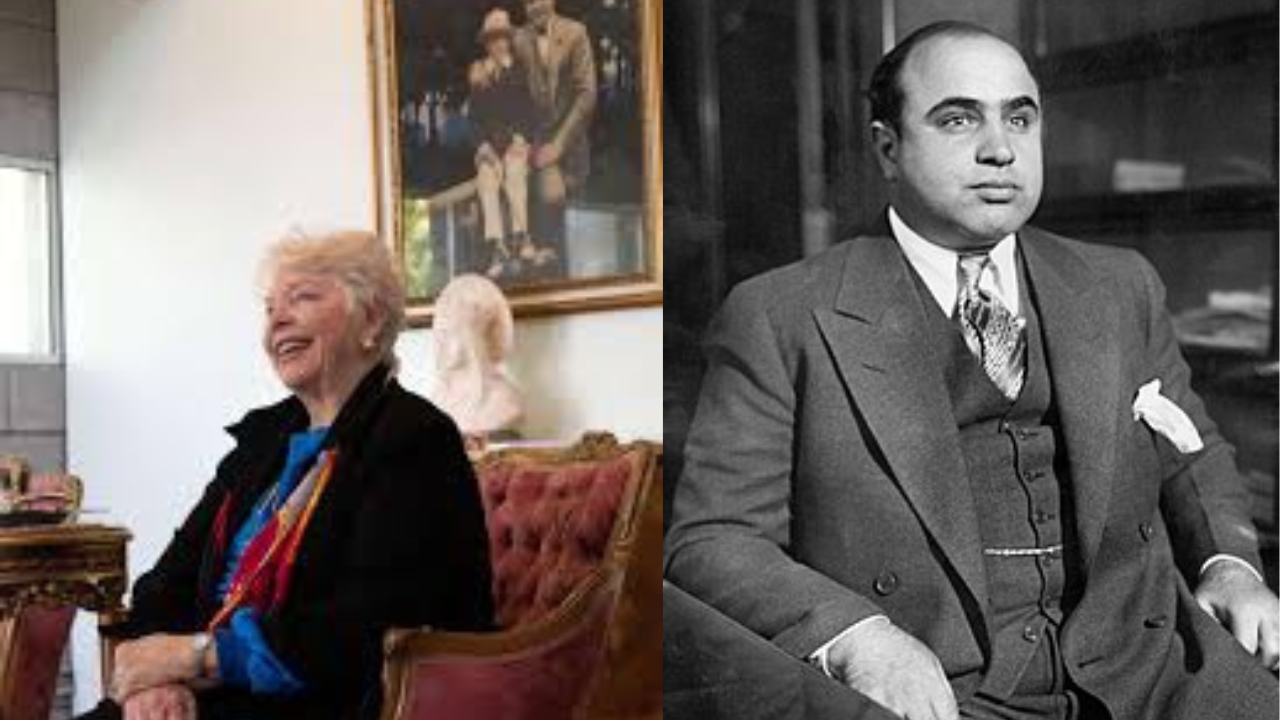
When we hear the name Capone, our minds immediately conjure images of Chicago’s violent Prohibition era, tommy guns, bootlegging operations, and one of America’s most notorious gangsters. Al Capone‘s criminal empire and eventual downfall have been immortalized in countless films, books, and documentaries. Yet, behind this infamous legacy lived real people—family members who bore the weight of a name synonymous with organized crime.
Veronica Frances Capone, affectionately known as “Ronnie,” was born into this complex inheritance. As the oldest granddaughter of Al Capone, she carried a surname that opened doors to curiosity, judgment, and unwanted attention. However, Veronica’s story is not one of continued criminality or attempts to capitalize on notoriety. Instead, it’s a quieter narrative about an ordinary woman who worked diligently to build a normal life far removed from her grandfather’s dark shadow.
This article explores the life of Veronica Capone—a woman who knew Al Capone not as “Scarface” or “Public Enemy Number One,” but simply as “Papa,” a loving grandfather who passed away when she was just four years old. Her journey from Miami Beach to California, her career in the semiconductor industry, and her family’s ultimate decision to part with Al Capone’s personal artifacts tells a deeply human story about identity, legacy, and the desire for normalcy.
Quick Info
| Full Name | Veronica Frances “Ronnie” Capone (later Bacon) |
|---|---|
| Birth Year | 1943 |
| Birthplace | Miami Beach, Florida, USA |
| Death | November 17, 2007 (Age 64) |
| Place of Death | Auburn, California, USA |
| Parents | Albert Francis “Sonny” Capone & Diana Ruth Casey |
| Grandparents | Al Capone & Mae Capone |
| Siblings | Diane, Barbara, and Theresa |
| Spouse | Robert Warren Bacon (married 1963) |
| Career | Administrative and managerial roles in semiconductor industry |
| Notable Fact | Oldest granddaughter of infamous mobster Al Capone |
Early Life: Growing Up as Al Capone’s Granddaughter
Birth and Family Background
Veronica Frances Capone entered the world in 1943 in Miami Beach, Florida, during a period when her grandfather’s criminal empire had already crumbled. By the time of her birth, Al Capone had been released from Alcatraz Federal Penitentiary after serving time for tax evasion, his health severely deteriorated from untreated syphilis that would eventually claim his life.
She was born to Albert Francis Capone, known affectionately as “Sonny,” Al Capone’s only legitimate child. Sonny himself had lived a challenging life—partially deaf due to a childhood infection, he grew up under the enormous pressure of being the son of America’s most infamous gangster. He married Diana Ruth Casey, and together they built a family that would include four daughters: Veronica, Diane, Barbara, and Theresa.
Miami Beach provided a relatively sheltered environment for the Capone grandchildren. Far from Chicago’s violent streets where Al Capone had built his criminal reputation, South Florida offered warm weather, ocean breezes, and a degree of anonymity that would have been impossible in Illinois.
Knowing “Papa”: Memories of Al Capone
What distinguished Veronica’s childhood from most others was the identity of her grandfather. While the world knew him as a ruthless mobster responsible for countless violent crimes, including the infamous St. Valentine’s Day Massacre, Veronica and her sisters knew a different man entirely.
To these young girls, Al Capone was simply “Papa”—a doting grandfather who showed them affection and attention during his final years. By the time Veronica was born, Al Capone’s mental faculties had significantly declined due to neurosyphilis. The once-commanding crime boss had been reduced to a man with the mental capacity of a young child, unable to harm anyone and largely unaware of his former life.
Veronica was only four years old when Al Capone died on January 25, 1947, from cardiac arrest following a stroke. Her memories of him, if any remained into adulthood, would have been fragmentary—perhaps impressions of a large, affectionate presence rather than detailed recollections. Yet this brief connection to her grandfather would influence the trajectory of her entire life, even as she worked to distance herself from his legacy.
A Childhood Marked by an Infamous Name
Growing up with the Capone surname presented unique challenges for Veronica and her sisters. Even as young children, they couldn’t escape the curiosity, whispers, and sometimes outright hostility that accompanied their family name.
Teachers, neighbors, and strangers all had preconceived notions about what it meant to be a Capone. Some were fascinated, treating the girls like living museum pieces connected to a notorious historical figure. Others were judgmental, assuming criminality ran in the bloodline. Still others were fearful, uncomfortable with the association to organized crime.
Their father, Sonny, worked hard to provide as normal an upbringing as possible. He pursued legitimate business ventures and tried to shield his daughters from the worst aspects of public scrutiny. Yet the Capone name carried undeniable weight—it opened some doors while slamming others shut, created opportunities while simultaneously limiting them.
Building a Life Beyond the Legacy
The Name Change: Becoming the Browns
By 1966, when Veronica was in her early twenties, her father made a consequential decision that reflected the family’s desire for normalcy. Albert Francis Capone legally changed the family surname to “Brown”—one of the most common surnames in America, chosen specifically for its anonymity.
This wasn’t an attempt to hide or escape legal consequences; Sonny Capone had never been involved in criminal activities. Rather, it was a practical decision aimed at giving his daughters and their future families a chance at ordinary lives. As “Browns,” they could apply for jobs, introduce themselves to new people, and move through the world without the immediate baggage of their notorious connection.
For Veronica, who had already married Robert Warren Bacon in 1963, the name change came after she’d already established her adult identity. However, it represented something symbolically important—a family’s collective decision to prioritize present and future over a past they’d never chosen.
The choice of “Brown” was deliberate in its ordinariness. Unlike “Smith” or “Jones,” which might have seemed too obviously assumed, “Brown” was common enough to blend in while avoiding suspicion. It allowed the family to finally experience what they’d always wanted: to be unremarkable, to be judged on their own merits rather than their grandfather’s crimes.
Marriage and Personal Life
In 1963, at approximately twenty years old, Veronica married Robert Warren Bacon. Little public information exists about their courtship or marriage, which is precisely how the couple seemed to prefer it. Unlike some descendants of notorious figures who sought publicity or tried to capitalize on their famous connections, Veronica and Robert chose privacy.
Their marriage represented Veronica’s continuing effort to build a conventional life. As Mrs. Bacon, she gained yet another layer of separation from the Capone identity. She was no longer Veronica Capone or even Veronica Brown in many contexts—she was simply Ronnie Bacon, a married woman building a life with her husband.
The couple eventually settled in Northern California, with later years spent in Auburn, a small city in Placer County situated in the Sierra Nevada foothills. This geographic choice—far from Chicago’s urban intensity and even from Miami’s Capone associations—further reflected Veronica’s desire for distance from her grandfather’s legacy.
California in the 1960s and 1970s offered opportunities for reinvention. The state’s booming economy, particularly in emerging technology sectors, provided employment prospects that had nothing to do with family connections or notorious surnames. For someone seeking to build an identity independent of inherited infamy, California represented possibility.
Professional Life: Career in the Semiconductor Industry
Working in Technology’s Growing Sector
One of the most revealing aspects of Veronica Capone’s life was her career choice. Rather than pursuing fields where the Capone name might have held fascination—entertainment, writing, or even criminal justice—she chose administrative and managerial work in the semiconductor industry.
This career path demonstrates Veronica’s pragmatic approach to life. The semiconductor industry, especially in Northern California where Silicon Valley was beginning its ascent to global dominance, offered stable employment with growth potential. It was decidedly unglamorous work—the kind of behind-the-scenes administrative support that keeps technical operations running smoothly.
The Anonymity of Professional Competence
In choosing this career path, Veronica found something invaluable: the ability to be evaluated on her actual skills and performance rather than her famous surname. Office managers and administrative professionals aren’t hired based on family connections or notoriety—they’re hired for organizational ability, attention to detail, reliability, and interpersonal skills.
Veronica’s colleagues in the semiconductor industry likely had no idea they were working alongside Al Capone’s granddaughter. She was simply Ronnie, the competent administrator who kept things running efficiently. This professional anonymity must have been liberating after a childhood marked by constant awareness of her family history.
The semiconductor industry’s focus on innovation and forward-thinking also provided symbolic distance from the past. While her grandfather’s era represented Prohibition-age Chicago with its violence and corruption, Veronica’s work contributed to the technological revolution that would define late 20th-century America. The contrast couldn’t have been more stark or more intentional.
A Quiet Dignity in Ordinary Work
There’s something admirable about Veronica’s career choices. She could have attempted to monetize her connection to Al Capone through books, interviews, or memorabilia sales during her lifetime. The public’s fascination with her grandfather certainly would have provided opportunities for financial gain through exploitation of the family name.
Instead, Veronica chose honest work in an industry where she contributed value through her labor and skills. This decision reflects a dignity and self-respect that speaks volumes about her character. She wanted to earn her way through life rather than profit from her grandfather’s criminal notoriety.
Her career also provided financial independence and stability. Rather than relying on family wealth or trading on the Capone name, she supported herself through her own efforts. This independence was both practical and symbolic—proof that she was her own person, not merely Al Capone’s granddaughter.
Life in Northern California and Oregon
Choosing the West Coast
Veronica’s decision to spend much of her adult life in Northern California and Oregon represented both practical and symbolic choices. These West Coast locations offered maximum geographic and cultural distance from the Midwest cities associated with her grandfather’s criminal activities.
Northern California in the latter half of the 20th century was experiencing tremendous growth and transformation. The region’s natural beauty, economic opportunities, and culture of reinvention made it an ideal destination for someone seeking to build a new identity. The area’s relative newness—compared to established Eastern cities—meant fewer entrenched social hierarchies based on family background.
Auburn, California, where Veronica eventually settled and where she would pass away, is a small city of fewer than 15,000 residents. Located about 30 miles northeast of Sacramento in the Sierra Nevada foothills, Auburn offers a quiet, semi-rural lifestyle far removed from urban intensity. Its historic Gold Rush origins and focus on outdoor recreation create an environment where individual identity matters more than family history.
The Threat of Wildfires and Family Heirlooms
Veronica’s choice of Northern California, while offering many advantages, also came with environmental risks. The region’s increasing vulnerability to catastrophic wildfires would eventually influence her family’s decisions about Al Capone’s personal artifacts that had been preserved for decades.
According to her sister Diane, the constant threat of Northern California wildfires became a significant concern for the family regarding the extensive collection of Al Capone memorabilia they’d inherited. These items included personal correspondence, photographs, jewelry, household items, and other artifacts from their grandfather’s life.
Living in an area where wildfires could destroy everything with little warning created genuine anxiety about preserving these historical items. While the objects represented a complicated legacy, they were still family heirlooms with historical significance. The thought of losing them to natural disaster rather than ensuring they were properly preserved troubled the sisters.
This environmental reality would eventually contribute to the family’s decision, made years after Veronica’s death, to auction the collection rather than risk its destruction.
The Capone Family Legacy: Preservation and Release
Life After Veronica
Veronica Capone Bacon passed away on November 17, 2007, at the age of 64 in Auburn, California. While specific details about her death weren’t widely publicized—consistent with the privacy she’d maintained throughout her life—her passing marked the end of a generation that had direct childhood memories of Al Capone.
Her surviving sisters—Diane, Barbara, and Theresa—faced decisions about what to do with the extensive collection of family artifacts they’d preserved for over seven decades. These weren’t items acquired by collectors or historians; they were personal belongings that had passed from Al and Mae Capone to their son Sonny, and then to his daughters.
The 2021 Estate Auction
In 2021, fourteen years after Veronica’s death, her sisters made the decision to auction their grandfather’s personal estate through Witherell’s Auction House in Sacramento, California. The collection was extraordinary both in scope and intimacy—over 170 family heirlooms that provided unprecedented glimpses into Al Capone’s personal life.
Items included:
- Al Capone’s favorite Colt .45 pistol
- Diamond-encrusted jewelry and pocket watches
- Personal correspondence and photographs
- Christmas cards and family mementos
- Furniture from the Capone family home
- Cigars, prescription bottles, and everyday personal items
The auction attracted international attention and ultimately generated approximately $3 million in sales. Collectors, museums, and Capone enthusiasts competed for pieces of history that had been carefully preserved by the family for generations.
The Reasoning Behind the Sale
Diane Capone, speaking for the surviving sisters, explained their decision through several lenses. The wildfire threat was significant—knowing that a single catastrophic fire could destroy irreplaceable historical artifacts created urgency about finding them permanent homes.
But there were other considerations as well. The sisters were aging, and none of their own children showed interest in maintaining the collection. Rather than letting the items scatter randomly through estate sales after their deaths, the sisters chose to thoughtfully release them while they could still control the process.
There was also a sense of relief in finally letting go. For over seventy years, the family had carried the burden of these objects—physical reminders of a complicated legacy. The artifacts were historically valuable but emotionally heavy. Releasing them allowed the surviving sisters to lighten that load.
Veronica’s Likely Perspective
Though Veronica didn’t live to see the auction, her life choices suggest she would have understood and perhaps supported her sisters’ decision. She’d spent her entire adult life creating distance from the Capone legacy, choosing anonymity over notoriety, honest work over exploitation of her family name.
The auction represented a final separation—a way for the family to acknowledge Al Capone’s historical significance while also releasing themselves from the obligation of preserving his memory. The items would go to people who valued them for historical reasons, properly preserved and documented, while the family could finally close that chapter completely.
Understanding Veronica’s Legacy
A Life Defined by Choices, Not Inheritance
Veronica Capone’s story matters precisely because it’s not dramatic. She didn’t follow in her grandfather’s criminal footsteps. She didn’t write tell-all books or give sensational interviews. She didn’t try to rehabilitate Al Capone’s reputation or deny his crimes. Instead, she simply lived—working, building relationships, pursuing normalcy with determination and dignity.
Her legacy is one of personal agency in the face of inherited infamy. She demonstrated that family history, no matter how notorious, doesn’t have to determine individual destiny. Through conscious choices about where to live, what name to use, what career to pursue, and what level of privacy to maintain, Veronica crafted a life that was fundamentally her own.
The Challenge of Famous Ancestry
Veronica’s experience reflects a broader truth about descendants of notorious figures. Whether the grandchildren of dictators, criminals, or other infamous individuals, these family members face unique challenges that most people never encounter.
They must constantly navigate questions about their identity: Are they defined by their ancestor’s actions? Do they bear responsibility for crimes committed before their birth? Should they publicly denounce their family member, or does family loyalty transcend moral judgment? How can they build authentic identities when others see them primarily through the lens of their famous relative?
Veronica’s approach—deliberate privacy, geographic distance, name changes, and career choices unrelated to her family history—represents one strategy for managing this challenge. It may not be the only valid approach, but it clearly worked for her, providing the peaceful, ordinary life she sought.
Historical Significance
While Veronica lived quietly, her existence and that of her sisters provided important historical continuity. They were living links to one of America’s most notorious criminals, possessing family stories, artifacts, and perspectives that no historian or biographer could access otherwise.
The 2021 auction of their grandfather’s personal items offered researchers and the public unprecedented access to the human side of Al Capone—the family man behind the gangster persona. These artifacts survived because Veronica and her sisters preserved them, even while personally seeking distance from what they represented.
In this way, Veronica contributed to historical understanding while maintaining her personal boundaries—allowing objects to tell stories she chose not to tell herself.
Frequently Asked Questions (FAQs)
Who was Veronica Capone?
Veronica Frances “Ronnie” Capone (1943–2007) was the oldest granddaughter of the infamous American mobster Al Capone. Born in Miami Beach, Florida, to Al Capone’s only child, Albert Francis “Sonny” Capone, she lived a private, law-abiding life working in the semiconductor industry, deliberately distancing herself from her grandfather’s criminal legacy.
Did Veronica know her grandfather, Al Capone?
Yes, but only during her early childhood. Veronica was born in 1943, and Al Capone died in January 1947 when she was four years old. She and her sisters remembered him affectionately as “Papa,” a loving and attentive grandfather, though by that time his health and mental faculties had severely declined due to neurosyphilis.
Why did the Capone family change their surname to Brown?
In 1966, Veronica’s father, Sonny Capone, legally changed the family surname to “Brown” to help his daughters escape the infamy and scrutiny associated with the Capone name. The change was intended to give Veronica and her sisters the opportunity to live normal lives, apply for jobs, and interact with the public without the burden of their notorious family history.
What was Veronica Capone’s career?
Veronica worked in administrative and managerial roles within the semiconductor industry. She chose a career path that allowed her to be evaluated on her professional competence and skills rather than her family name, finding anonymity and stability in the growing technology sector of Northern California.
Did Veronica Capone get married?
Yes, Veronica married Robert Warren Bacon in 1963. After her marriage, she was often known as Ronnie Bacon, which provided an additional layer of separation from the Capone identity. The couple lived a quiet life, primarily in Northern California and Oregon.
Conclusion
Veronica Frances Capone lived from 1943 to 2007, spanning six decades of profound American social, cultural, and technological change. Born into one of the country’s most infamous families, she could have allowed that association to define her entire existence. Instead, through deliberate choices and quiet determination, she built a life remarkable primarily for its ordinariness.
She knew her grandfather as “Papa,” a affectionate presence during her first four years before his death diminished by disease left him a shadow of the fearsome crime boss he’d once been. She grew up bearing a surname that carried enormous baggage, eventually participating in her family’s decision to legally change it to the anonymous “Brown.”
She married Robert Warren Bacon, establishing yet another layer of identity separate from her birth family. She built a career in the semiconductor industry based on her own competence rather than family connections. She chose to live in Northern California and Oregon, far from the Chicago and Miami locations associated with her grandfather’s legacy.
When she died at 64 in Auburn, California, Veronica left behind sisters who would eventually make peace with their family history by auctioning Al Capone’s personal artifacts—a final release from the weight of inherited notoriety.